
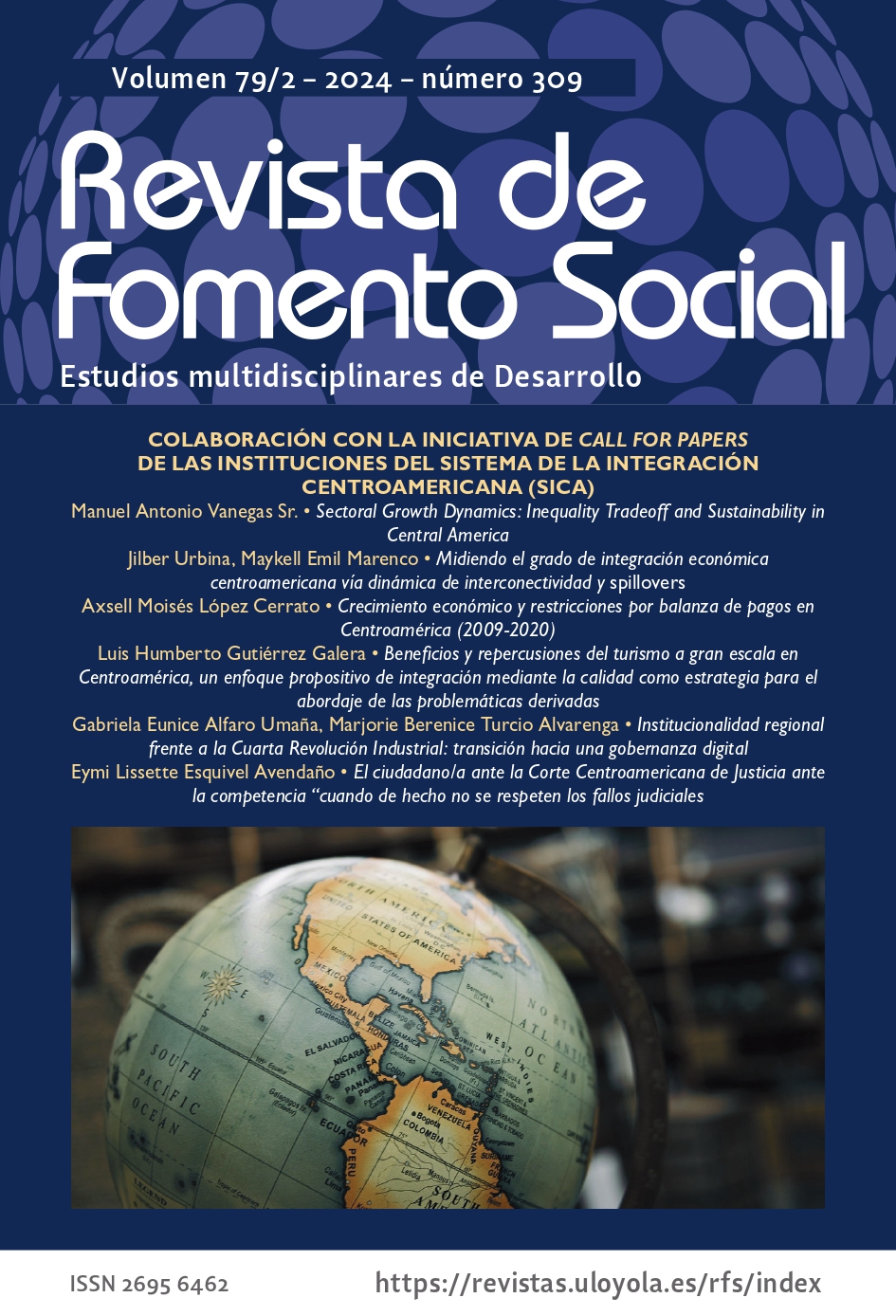
Measuring the degree of Central American economic integration via interconnectivity dynamics and spillovers
Article Sidebar
Main Article Content
Abstract
Recent economic, trade, health, political and social shocks have shown that the integration process in the Central American region is based on close relationships that have a profound impact on the economic performance of each of the members of the integration bloc (economic interdependence). In this sense, this study examines the level of integration in the region in order to identify those countries that could be classified as senders or receivers of integration impulses and the position of integration in the face of shocks of different natures. Using an interconnectivity index based on the variance decomposition of the forecast error variance of a vector autoregressive (VAR) model, applied to the Monthly Index of Economic Activity (MAEI) of each country, it is shown that the index is capable of satisfactorily capturing the ‘comovements’ of the integration process and identifies the moments of boom and slowdown in the Central American integration impulse.
Downloads
Article Details
The authors acknowledge that the Revista de Fomento Social assumes as its own the intellectual property rights over their work and grant the journal the permissions of distribution and public communication of the same established in the Berlin, Bethesda and Budapest declarations; for this reason they accept that the work presented be distributed in open access, protecting the copyright under a "Creative Commons Attribution-NonCommercial-NoDerivativeWorks 4.0 (CC BY-NC-ND) license.

You may copy, use, disseminate, transmit and publicly display provided that:
Cite the authorship of the work, the publication in Revista de Fomento Social, issue, year and the pages where you found the information.
No commercial benefit may be obtained.
No derivative works may be made for commercial purposes that are not authorized by the journal.
Authors are encouraged to disseminate the article electronically (Revista de Fomento Social, number, year, pagination, ISSN, DOI, etc.), in order to favor its circulation and diffusion, increase its citation and reach among the academic community.
The information of the journal will be provided to Dulcinea
References
Banco Central de Reserva de El Salvador. (2018). Informe de Estabilidad Financiera. San Salvador, El Salvador: Banco Central de Reserva de El Salvador.
Bo, C., & Woo, P. (2008). A Composite Index of Economic Integration in the Asia-Pacific Region. Simon Fraser University and Asia Pacific Foundation of Canada.
Cáceres, L. (1994). Costos y Beneficios de la Integración Centroamericana. Revista de la CEPAL (Comisión Económica para América Latina y el Caribe), 111-128.
Cáceres, L. (2021). Productividad Laboral y la Integración Económica Centroamericana: El caso de El Salvador. Revista CEPAL, 2-22.
(FMI) Fondo Monetario Internacional. (2018). Perspectivas Económicas: Las Américas. Una recuperación Despareja.
Diebold, F. y K. Yilmaz (2009), “Measuring Financial Asset Return and Volatility Spillovers, with Application to Global Equity Markets,” Economic Journal, vol. 119, no. 534, 158-171.
Diebold, F. y K. Yilmaz (2012): “Better to Give than to Receive: Predictive Directional Measurement of Volatility Spillovers,” International Journal of Forecasting, vol 28, no 1, 57–66.
Diebold, F. y K. Yilmaz (2015): Financial and Macroeconomic Connectedness A Network Approach to Measurement and Monitoring. Oxford University Press.
Eastern Partnership Civil Society Forum. (2017). Eastern Partnership Index 2015 - 2016. Bruselas, Belgium: Eastern Partnership Civil Society Forum.
Espinoza Valverde, E., & Salazar Recinos, J. (11 de octubre de 2016). Índice Regional de Integración Económica Centroamericana (IRIEC) [Diapositivas de PowerPoint]. Obtenido de Centro de Estudios para la Integración Económica-SIECA.
Flores, C. R. (2003). Integración Económica Centromericana y Crecimiento Económico. SICA, 1-16.
König, J. y Ohr, R. (2012). Homogeneous groups within a heterogeneous community – Evidence from an index measuring European economic integration.
Lütkepohl, Helmut (2005). New Introduction to Multiple Time Series Analysis. Springer
Martínez Peinado, J. (1997). Globalización: Elementos para el debate, Ponencia presentada en el seminario internacional "La economía mundial contemporánea. Balance y Perspectiva". UAP, Puebla.
Pesaran, M. H. y Shin, Y (1998). Generalized impulse-response analysis in linear multivariate models. Economics Letters. 58(1): 17-29.
Petit Primera, J. (2014). La Teoría Económica de la Integración y sus Principios Fundamentales. Revista Venezolana de Análisis de Coyuntura, 137-162.
(SELA) Sistema Económico Latinoamericano y del Caribe. (2016). Índice de Integración de América Latina y el Caribe. SELA, 3-45.
(SIECA) Secretaría de Integración Económica Centroamericana. (2019). Perspectivas Económicas y Comerciales 2019. "Desaceleración económica regional en un entorno mundial de tensión comercial.". Ciudad de Guatemala, Guatemala: Centro de Estudios para la Integración Económica.
(SIECA) Sistema de Integración Económica Centroamericana. (2019). Informe Económico Regional 2018-2019. Ciudad de Guatemala, Guatemala: Centro de Estudios para la Integración Económica (CEIE).
Tamanes, R. (1990). Estructura Económica Internacional. Alianza Editorial, Madrid.
Tinbergen, J. (1954). International economic integration, Elsevier. Elsevier, Amsterdam.
Urbina, J. (2013). Financial Spillovers Across Countries: Measuring Shock Transmissions. MPRA Paper 75756, University Library of Munich, Germany.
Urbina J (2021). Spillover: Spillover Index Based on VAR Modelling. R package version 0.1.0.1. The Comprehensive R Archive Network