
Women’s empowerment in the coffee sector in Honduras
Article Sidebar
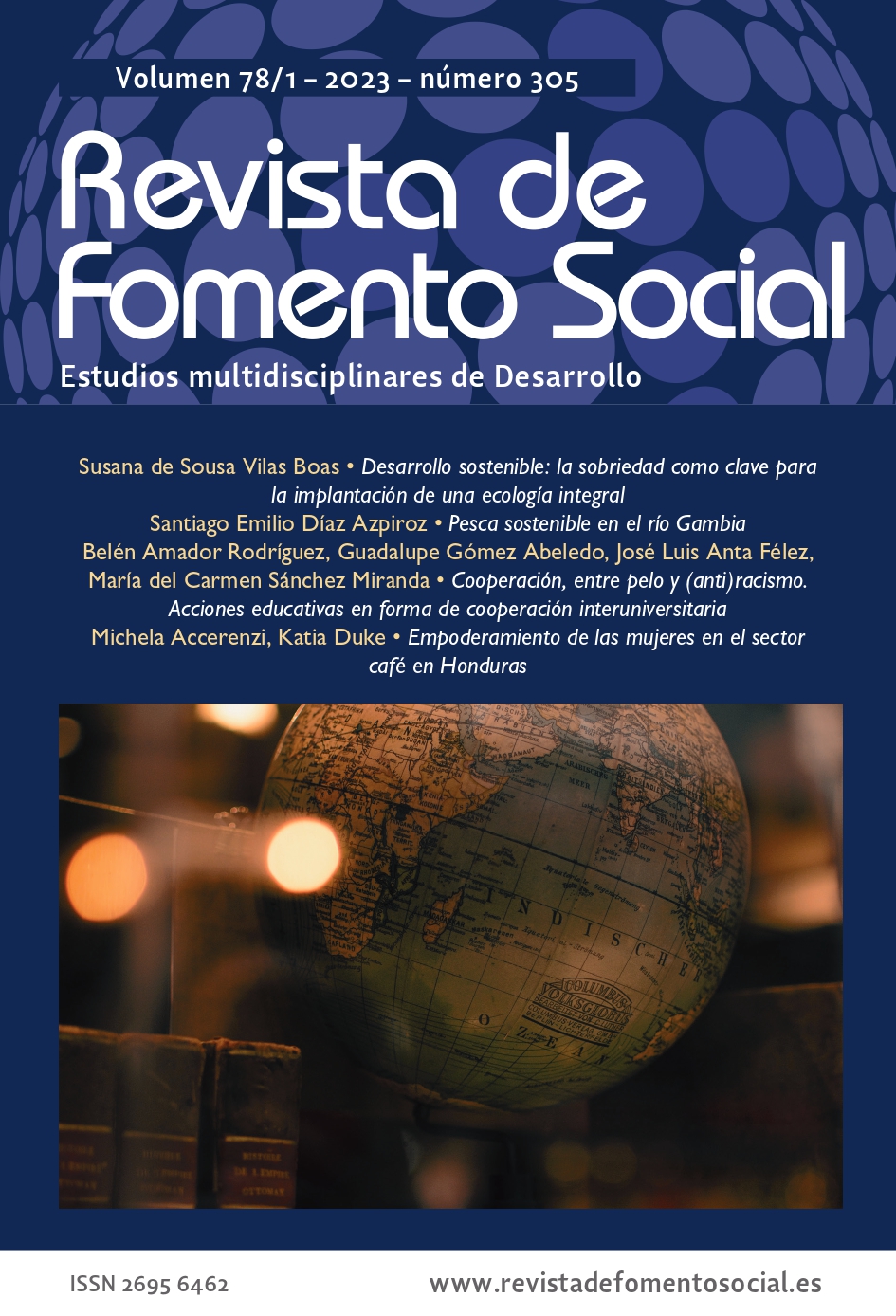
Main Article Content
Abstract
An empowerment strategy must bring about changes in social structures and power relations. The degree of empowerment also depends on the combination of agency and opportunity structure, in which the access to and the control of resources, the ability to make decisions and the final results are central elements. Therefore, empowerment includes both individual change and collective action, and implies the radical alteration of the processes and structures that reproduce the subordinate position of women as a gender.
Coffee represents the largest agricultural product in Honduras. However, women do not enjoy equal access to resources, nor do they have the same voice in decisions; furthermore, they also carry a disproportionate burden of roles inside and outside the household.
This article analyses the barriers and opportunities of the Honduran coffee sector for the empowerment of women, using an ethnographic approach.
Downloads
Article Details
The authors acknowledge that the Revista de Fomento Social assumes as its own the intellectual property rights over their work and grant the journal the permissions of distribution and public communication of the same established in the Berlin, Bethesda and Budapest declarations; for this reason they accept that the work presented be distributed in open access, protecting the copyright under a "Creative Commons Attribution-NonCommercial-NoDerivativeWorks 4.0 (CC BY-NC-ND) license.

You may copy, use, disseminate, transmit and publicly display provided that:
Cite the authorship of the work, the publication in Revista de Fomento Social, issue, year and the pages where you found the information.
No commercial benefit may be obtained.
No derivative works may be made for commercial purposes that are not authorized by the journal.
Authors are encouraged to disseminate the article electronically (Revista de Fomento Social, number, year, pagination, ISSN, DOI, etc.), in order to favor its circulation and diffusion, increase its citation and reach among the academic community.
The information of the journal will be provided to Dulcinea
References
Coffee Quality Institute (2017). The Way Forward: Accelerating Gender Equity in the Coffee Value Chain. A practical guide with recommendations for action. CQI’s Partnership for Gender Equity. http://www.coffeeinstitute.org/genderreport/
Foucault, M. (1992). Microfísica del poder. Edición y traducción de Julia Varela y Fernando Álvarez-Uría.
FRIDE (2006). “El individuo como agente de cambio: El proceso de empoderamiento”. Desarrollo “En perspectiva”.
Kabeer, N. (1999). The Conditions and Consequences of Choice: Reflections on the Measurement of Women’s Empowerment. UNRISD discussion paper n. 108
Instituto Hondureño del Café IHCAFE (2019). El sector café de Honduras. Avances, institucionalidad y desafíos. http://www.ico.org/documents/cy2016-17/Presentations/7th-forum-coffee-sector-honduras-c.pdf
IHCAFE (2022): Estadísticas de Café. Cosecha 2020/2021. Tegucigalpa, Honduras
Instituto Nacional de Estadística INE (2022). Estadísticas del comercio exterior. Mercancías generales. periodo enero-junio 2018-2022. https://www.ine.gob.hn/V3/imag-doc/2022/12/ESTAD%C3%8DSTICAS-DE-COMERCIO-EXTERIOR-ENERO-JUNIO-2018-2022-1.pdf
Martínez Miguelez, M. (2005). El Método Etnográfico de Investigación. http://prof.usb.ve/miguelm/metodoetnografico.html
Murguialday, C. (2013). Reflexiones feministas sobre el empoderamiento de las mujeres. Barcelona: Collección Cooperacció.
Oficina de Desarrollo Humano del Programa de las Naciones Unidas para el Desarrollo ODH/PNUD (2008). Desarrollo Humano, una cuestión de poder. Informe Nacional de Desarrollo Humano 2008. Santo Domingo, República Dominicana.
Orellana Peña, J. H. (2019). La socioeconomía del café y las intervenciones desarrollistas en la región occidental de Honduras. Revista Economía y Administración, Vol. 10, N.1. DOI: 10.5377/eya.v10i1.9045
Romero Zelaya, J. R., y Sibrian Navarro, F. J. (2016). Estudio de la estructura de mercado de la comercialización del café en Honduras. Honduras: Escuela Agrícola Panamericana, Zamorano.
Sen, A. (1987). Gender and cooperative conflicts. Wider Research Papers.
Spivak, G. C. (1988). Can the subaltern speak? Basingstoke: Macmillan
Villalba, U. (2007a). Condiciones para una participación emancipadora en el desarrollo. Congreso "El desafío del desarrollo humano. Propuestas locales para otra globalización”. Bilbao, Instituto Hegoa.
Villalba, U. (2007b). Participación y Desarrollo: ¿Capital Social y/o empoderamiento? Congreso "El desafío del desarrollo humano. Propuestas locales para otra globalización”. Bilbao, Instituto Hegoa.
Westmarland, N. (2001). “The Quantitative/Qualitative Debate and Feminist Research: A Subjective View of Objectivity”. Forum: Qualitative Social Research Sozialforschung. Volume 2 (1), Art. 13
Zabala, I. (2010). “Estrategias alternativas en los debates sobre género y desarrollo”. Revista de Economía Crítica, nº9, primer semestre 2010, ISSN: 2013-5254