
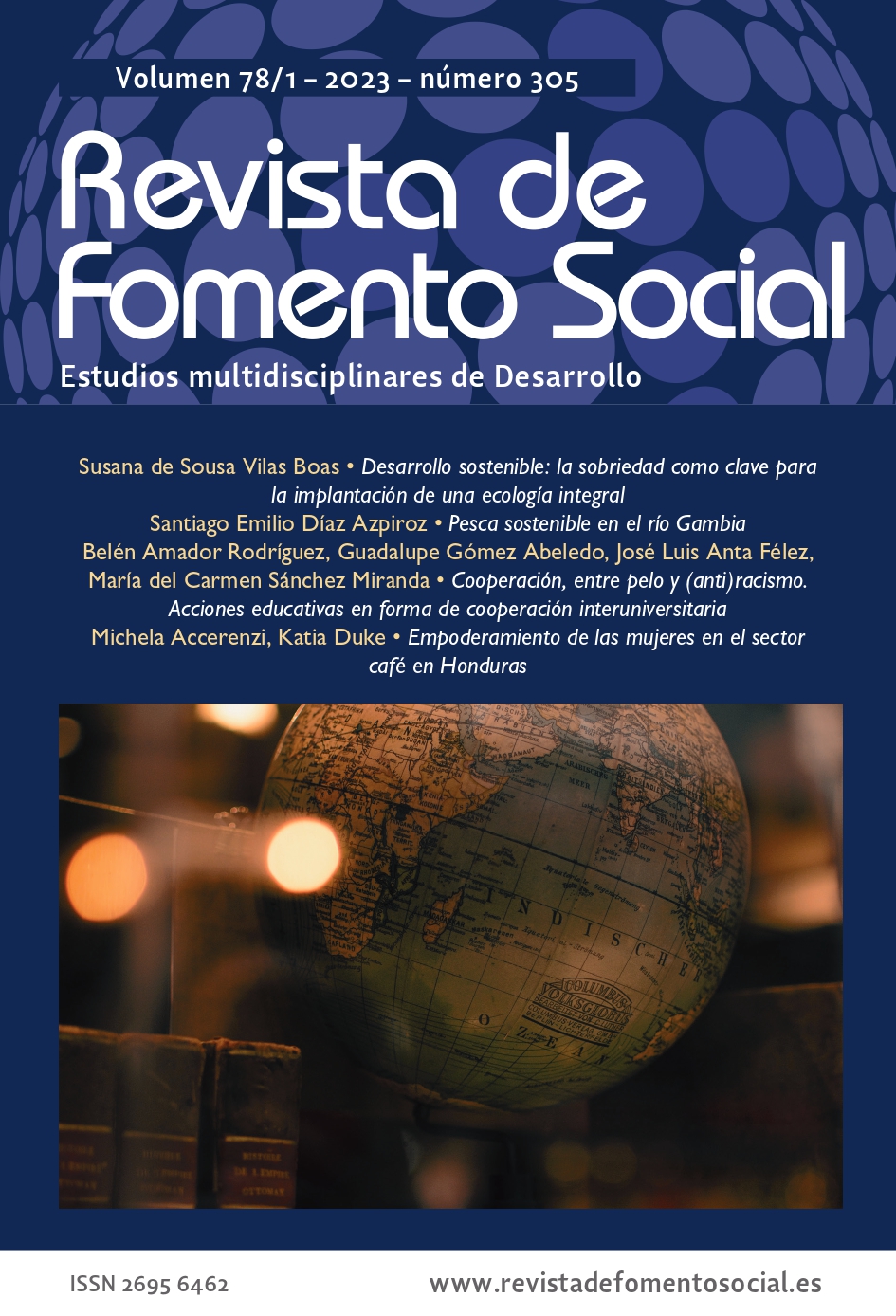
Sustainable development: sobriety as a key to the implementation of an integrated ecology
Article Sidebar
Main Article Content
Abstract
A la luz de la Encíclica Laudato Si' del Papa Francisco, defenderé la necesidad y la urgencia de implantar una ecocultura que haga posible vivir el presente y mirar al futuro más allá del miedo a la destrucción. Esta será posible Gracias a la sobriedad. Esta ecocultura será capaz de generar una acción de compasión por la Creación libre de desesperación o fatalismo, ya sean de índole económica o vinculados al equilibrio de los ecosistemas. Esta acción marcada por la sobriedad se basa en la autoconciencia humana. Cuando el ser humano se comprende a sí mismo como parte integrante de la Creación, sufre con ella cada vez que la destrucción sale victoriosa. En una ecocultura, el ser humano reasume su papel original en la Creación, abandonando toda ambición e intento de superioridad y buscará en su lugar el bien común de la Creación. Lo alentará a través del progreso técnico, las políticas y las relaciones sociales, entendidas estas como aliadas en la salvaguarda de la casa común y nunca sacrificadoras de la ecología integral.
Downloads
Article Details
The authors acknowledge that the Revista de Fomento Social assumes as its own the intellectual property rights over their work and grant the journal the permissions of distribution and public communication of the same established in the Berlin, Bethesda and Budapest declarations; for this reason they accept that the work presented be distributed in open access, protecting the copyright under a "Creative Commons Attribution-NonCommercial-NoDerivativeWorks 4.0 (CC BY-NC-ND) license.

You may copy, use, disseminate, transmit and publicly display provided that:
Cite the authorship of the work, the publication in Revista de Fomento Social, issue, year and the pages where you found the information.
No commercial benefit may be obtained.
No derivative works may be made for commercial purposes that are not authorized by the journal.
Authors are encouraged to disseminate the article electronically (Revista de Fomento Social, number, year, pagination, ISSN, DOI, etc.), in order to favor its circulation and diffusion, increase its citation and reach among the academic community.
The information of the journal will be provided to Dulcinea
References
Cooper, David (ed.), Growing Diversity, Genetic Resources and Local Food Security. (London. Intermediate Technology Publications, 1992).
Elbers, J.. Ciencia holística. Para el buen vivir: Una introducción. Centro Ecuatoriano de Derecho Ambiental (CEDA). (Quito: Manthra Editores, 2014).
Luengo, E. (coord.). Las alternativas ciudadanas para otros mundos
posibles: pensamiento y experiencias, (Guadalajara: ITESO, 2014).
Lutz, Chistopher Stephen. Reading Alasdair MacIntyre’s After Virtue (USA: Continuum, A&C Black, 2012).
MacIntyre, Alasdair. “Freedom and Revolution,” Labour Review 5, N. 1 (February-March 1960): 19-24.
Naredo, J.M.. Raíces económicas del deterioro ecológico y social. Más allá
de los dogmas. (Madri: Siglo XXI de España Editores S.A., 2006).
Pérez Alcalá, Gabriel. “Bienvenidos a la Universidad Loyola” in https://www.uloyola.es/universidad/quienes-somos/bienvenida.
Santos, Boaventura de Sousa (coord). Producir para vivir. Los caminos de la producción no capitalista. (México: Fondo de Cultura económica D.F., 2012).
Shiva, Vandana. Staying Alive; women, ecology and development. (London: Zed books, 1988)
Shiva, Vandana; Irene Dankelman. “Women Maintaining the Food Schain; a case study of India”. In: Nord-Süd Aktuell, 3 Quartal (1990): 373-375.
Universidad Loyola. “Identidad y misión. Los valores de la Universidad Loyola” in https://www.uloyola.es/universidad/quienes-somos/identidad-y-mision.