
El imperativo del Desarrollo
Article Sidebar
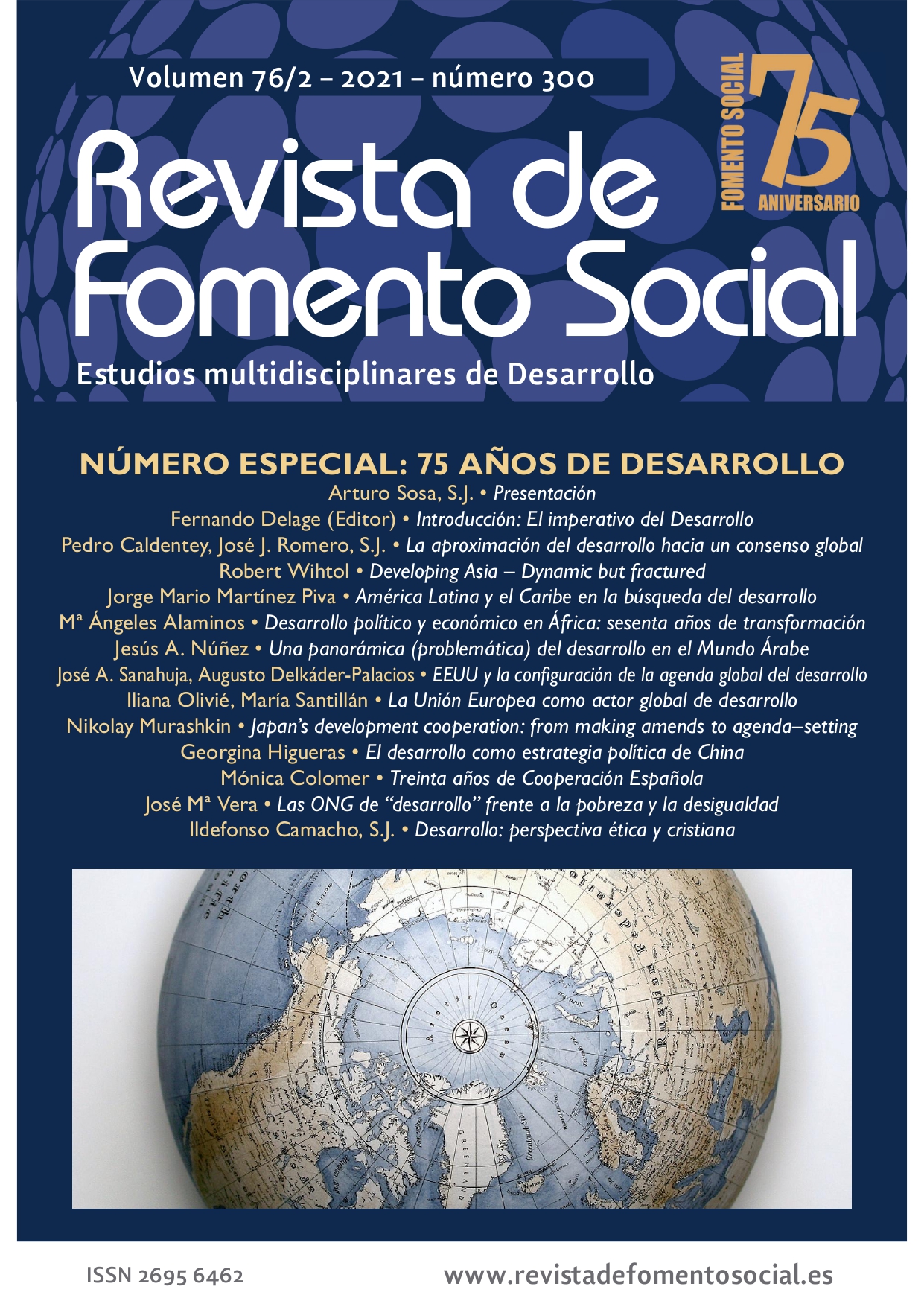
Main Article Content
Abstract
En marzo de 1946, a iniciativa de la Compañía de Jesús, nació Fomento Social: Revista de Sociología y de Moral Económica. Desconocemos si el subtítulo era un guiño a Adam Smith, filósofo moral antes que economista según se definió a sí mismo, pero el sabio escocés habría compartido con seguridad el objetivo que anunciaba la publicación en su primer número: “moralizar las relaciones económico–sociales de la Humanidad”. En cierto modo ese era también el propósito de quienes por aquel entonces habían diseñado un nuevo orden internacional tras concluir la Segunda Guerra Mundial.
Downloads
Article Details
The authors acknowledge that the Revista de Fomento Social assumes as its own the intellectual property rights over their work and grant the journal the permissions of distribution and public communication of the same established in the Berlin, Bethesda and Budapest declarations; for this reason they accept that the work presented be distributed in open access, protecting the copyright under a "Creative Commons Attribution-NonCommercial-NoDerivativeWorks 4.0 (CC BY-NC-ND) license.

You may copy, use, disseminate, transmit and publicly display provided that:
Cite the authorship of the work, the publication in Revista de Fomento Social, issue, year and the pages where you found the information.
No commercial benefit may be obtained.
No derivative works may be made for commercial purposes that are not authorized by the journal.
Authors are encouraged to disseminate the article electronically (Revista de Fomento Social, number, year, pagination, ISSN, DOI, etc.), in order to favor its circulation and diffusion, increase its citation and reach among the academic community.
The information of the journal will be provided to Dulcinea
References
CHOWDHURY, A. (2018). The Myth of International Order: Why Weak States Persist and Alternatives to the State Fade Away, Oxford, Oxford University Press.
EISENTRAUT, Sophie, ET AL. (2020). Polypandemic: Special Edition of the Munich Security Report, Munich Security Conference, noviembre 2020, https://doi.org/10.47342/CJAO3231
GADDIS, J. L. (2005). The Cold War, Londres, Allen Lane.
KANBUR, R. y SUMNER, A. (2012). “Poor Countries or Poor People?” Journal of International Development, 24 (6): 686–695.
NAYYAR, D. (2013). Catch Up: Developing Countries in the World Economy, Oxford, Oxford University Press.
PNUD (1990). Desarrollo Humano Informe 1990, http://hdr.undp.org/sites/default/files/hdr_1990_es_completo_nostats.pdf
PREBISCH, R. (1959). Commercial Policy in the Underdeveloped Countries, American Economic Review, 44: 251–273.
RADELET, S. (2015). The Great Surge: The Ascent of the Developing World, Nueva York, Simon and Schuster.
ROSTOW, W. W. (1960). The Stages of Economic Growth, Cambridge, Cambridge University Press.
SEN, A. (1999). Development as Freedom, Nueva York, Alfred A. Knopf.
SHAH, R. J. (2021). “The COVID Charter: A New Development Model for a World in Crisis“, Foreign Affairs, 100 (5): 179–191.