
South–South and Triangular Cooperation towards the SDGs Agenda: Opportunities and challenges of technology transfer as a tool for sustainable development and overcoming inequalities
Article Sidebar
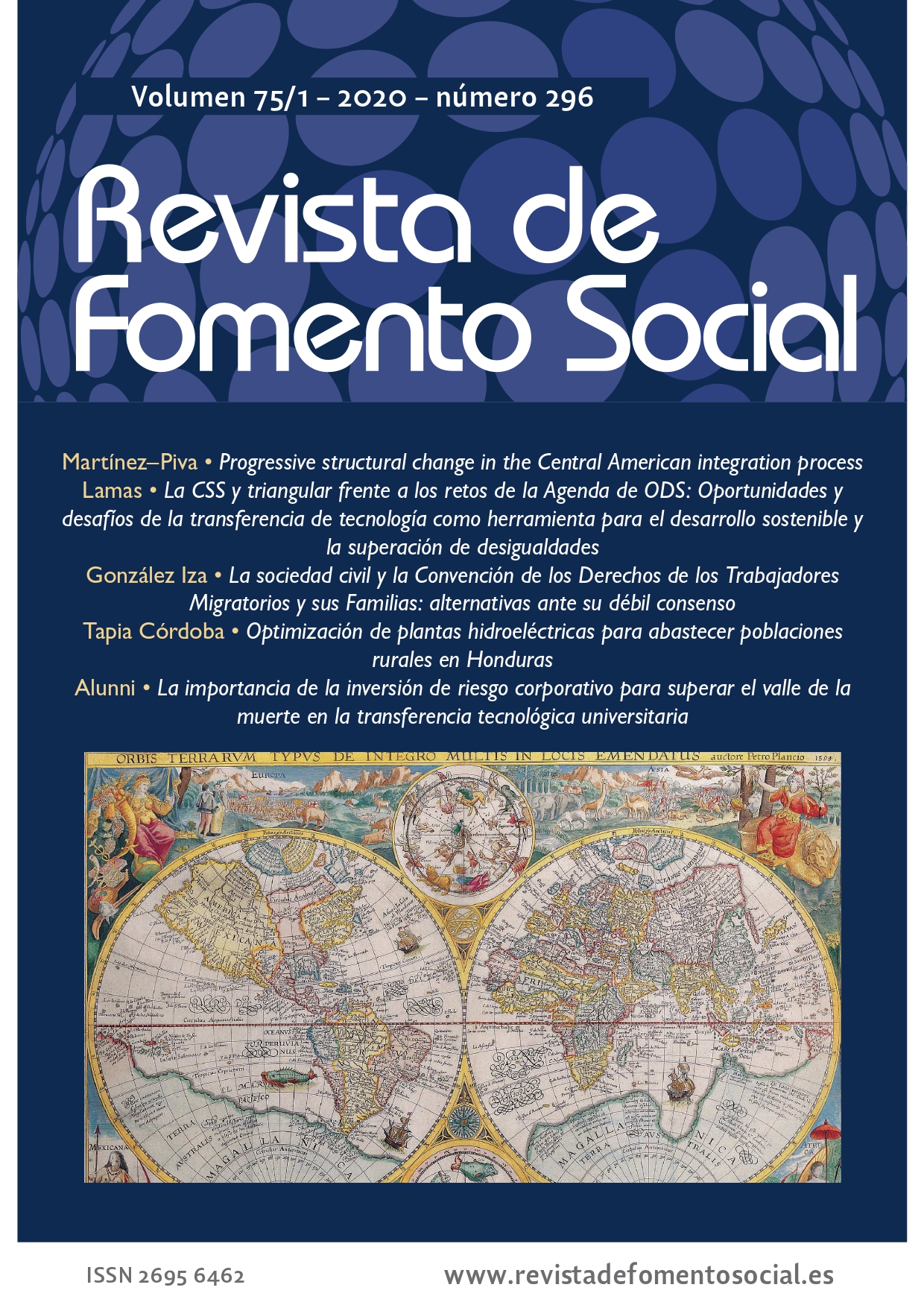
Main Article Content
Abstract
The paper aims to contribute on the reflections about the need to encourage cooperation and technology transfer, as a relevant tool for achieving the Sustainable Development Goals (SDGs) and reducing South inequalities. Although the actions in this sense are not new, the challenges continue to exist and have been transformed in their form and complexity; requiring, therefore, new approaches and innovative answers.
Based on this, the work questioning about the possible actions to be taken by the countries, in particular the Latin American ones –because it is the most unequal region in the world–, to face these challenges.
Based on this questioning, a brief analysis is carried out with the objective of identify some of the current challenges and opportunities for compliance with the SDGs and the reduction of inequalities in the South.
Based on the aforementioned analysis, some proposals are outlined focusing on the use of new exponential technologies as a key and innovative tool to achieve these objectives, based on their capacity to increase impacts at reduced costs; allowing at the same time, the reduction of the North–South technological gap, which delays global development and, therefore, the possibility of the SDGs overcoming.
The hypothesis that guided the work is related to the need of provide innovative answers and promote different partnerships and cooperation projects that involve different modalities and actors of the International System in achieving the SDGs and reducing inequalities. Finally, based on the analysis, the work proposes the implementation of a horizontal international cooperation based on the use of exponential technologies to overcome the SDGs and reduce inequalities, which it is proposed to be named: Exponential Cooperation (ExCo).
Downloads
Article Details
The authors acknowledge that the Revista de Fomento Social assumes as its own the intellectual property rights over their work and grant the journal the permissions of distribution and public communication of the same established in the Berlin, Bethesda and Budapest declarations; for this reason they accept that the work presented be distributed in open access, protecting the copyright under a "Creative Commons Attribution-NonCommercial-NoDerivativeWorks 4.0 (CC BY-NC-ND) license.

You may copy, use, disseminate, transmit and publicly display provided that:
Cite the authorship of the work, the publication in Revista de Fomento Social, issue, year and the pages where you found the information.
No commercial benefit may be obtained.
No derivative works may be made for commercial purposes that are not authorized by the journal.
Authors are encouraged to disseminate the article electronically (Revista de Fomento Social, number, year, pagination, ISSN, DOI, etc.), in order to favor its circulation and diffusion, increase its citation and reach among the academic community.
The information of the journal will be provided to Dulcinea
References
AYLLÓN, B. (2015), “La Cooperación Sur–Sur en América Latina y Caribe. De una época dorada a una fase incierta”, en CRIES “América Latina y el Caribe y el nuevo sistema internacional: Miradas desde el Sur”, Anuario de la Integración Regional de América Latina y el Caribe, n° 11. Coordinadora Regional de Investigaciones Económicas y Sociales, pp. 134–170.
BELLI, L. y CAVALLI, O. (Coords.) (2018), Gobernanza y regulaciones de Internet en América Latina. Análisis sobre infraestructura, privacidad, ciberseguridad y evoluciones tecnológicas en honor de los diez años de la South School on Internet Governance, FGV Direito Rio.
CEPAL (2014), “Cambio estructural para la igualdad. Una visión integrada del desarrollo”, Comisión Económica para América Latina–Naciones Unidas, Santiago de Chile, LC/G.2604.
— (2016), “Horizontes 2030: la igualdad en el centro del desarrollo sostenible”, Comisión Económica para América Latina–Naciones Unidas, Santiago de Chile, LC/G.2660.
ESTEVES, P. y ASSUNÇÃO, M. (2014), “South–South Cooperation and the International Battlefield: Between the OECD and the UN”, en Third World Quarterly, vol. 35, nº 10, pp. 1775–1790.
JESÚS, S. (2007), “Conocimiento, cooperación y desarrollo”, Revista Iberoamericana de Ciencia, Tecnología y Sociedad – CTS, vol. 3, nº 8, pp. 195–208.
LECHINI, G. (2009), “La cooperación Sur–Sur y la búsqueda de autonomía en América Latina ¿Mito o Realidad?”, Revista Relaciones Internacionales, nº 12, GERI – UA Madrid, España, pp. 55–81.
MALCALZA, B. (2009), Viejos y nuevos debates en torno a la ayuda internacional al desarrollo, Mirada4, FLACSO, Argentina, pp. 85–110.
MAZZUCATO, M. (2018), The value of everything: Making and Taking in the Global Economy, Allen Lane.
OJEDA, T. (2016), Relaciones internacionales y cooperación con enfoque Sur–Sur, Libros de la Catarata, Madrid.
ONU (2019), Report of the UN Secretary–General’s High–level Panel on Digital Cooperation “The Age of digital interdependence”.
ONU MUJERES (2018), Informe de seguimiento de los ODS “Transformar las promesas en acción: la igualdad de género en la Agenda 2030”.
PIFCSS – Programa Iberoamericano para el Fortalecimiento de la Cooperación Sur–Sur (2016), Iberoamérica frente al desafío de los Objetivos de Desarrollo Sostenible. Una mirada desde la Cooperación Sur–Sur, Seminario Internacional, CEPAL, Santiago de Chile.
SEGIB (2016), Informe de la Cooperación Sur–Sur en Iberoamérica, Secretaría General Iberoamericana, Madrid.
SURASKY, J. (2017), Cooperación Sur–Sur en la Agenda 2030 y hacia el PABA+40, Instituto de Relaciones Internacionales, Universidad Nacional de La Plata.