
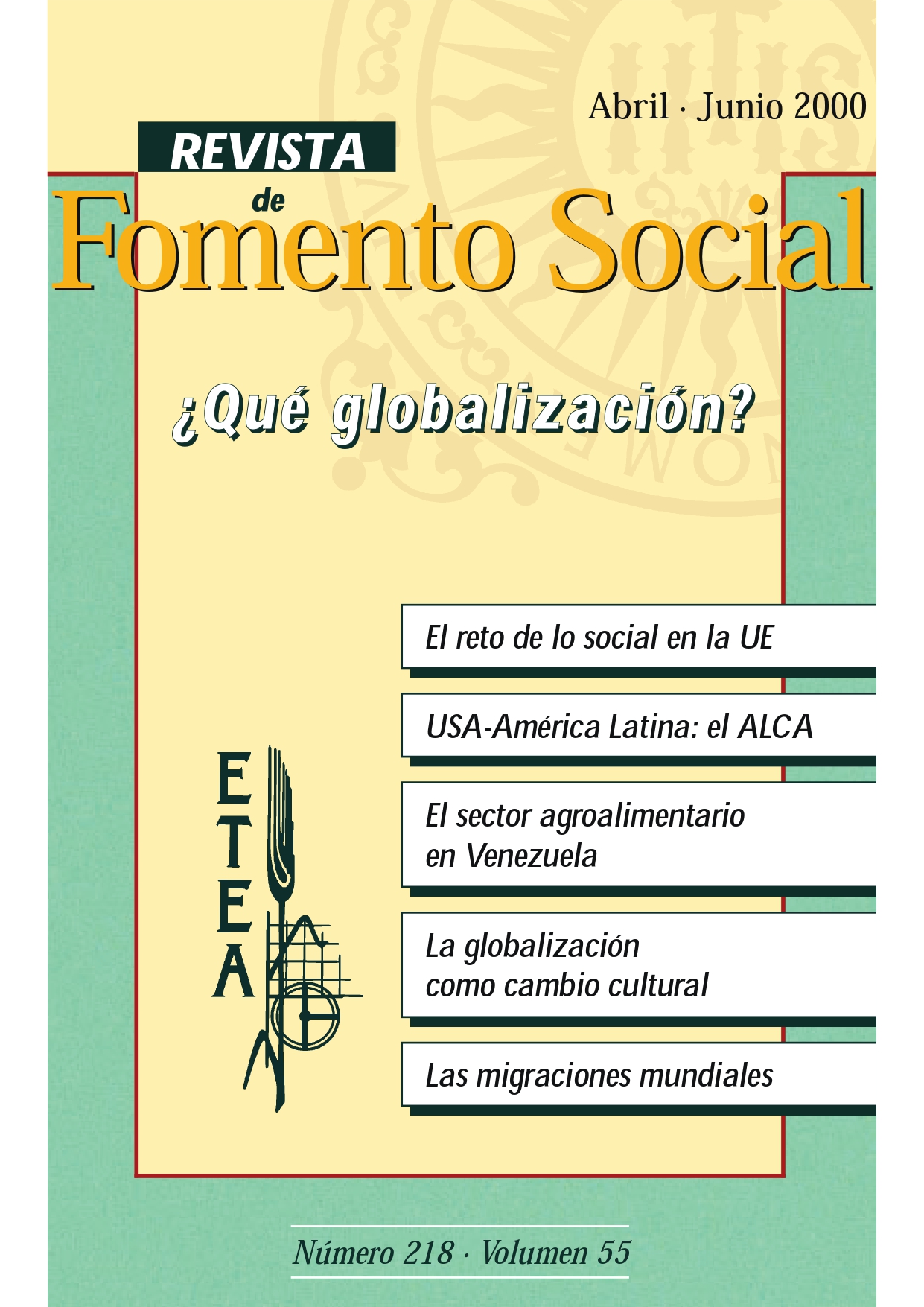
Migration in a globalised world
Article Sidebar
Main Article Content
Abstract
This article analyses the phenomenon of international migration on the part of the labour force, which has increased and will continue to do so as economic globalisation develops. In spite of growing xenophobia, there is a future for migration as it responds to a particular interest on the part of companies: to force labour costs down. If capital, goods, information, culture, fashion, music... increasingly cross frontiers, why shouldn’t workers do the same, when they hope to enjoy a higher standard of living or simply to survive in another country?
Downloads
Article Details
The authors acknowledge that the Revista de Fomento Social assumes as its own the intellectual property rights over their work and grant the journal the permissions of distribution and public communication of the same established in the Berlin, Bethesda and Budapest declarations; for this reason they accept that the work presented be distributed in open access, protecting the copyright under a "Creative Commons Attribution-NonCommercial-NoDerivativeWorks 4.0 (CC BY-NC-ND) license.

You may copy, use, disseminate, transmit and publicly display provided that:
Cite the authorship of the work, the publication in Revista de Fomento Social, issue, year and the pages where you found the information.
No commercial benefit may be obtained.
No derivative works may be made for commercial purposes that are not authorized by the journal.
Authors are encouraged to disseminate the article electronically (Revista de Fomento Social, number, year, pagination, ISSN, DOI, etc.), in order to favor its circulation and diffusion, increase its citation and reach among the academic community.
The information of the journal will be provided to Dulcinea
References
BÖHNING, W.R. (1999), The intra–Asian migration of workers with special reference to women, Brotherhood of Asian Trade Unionists (BATU), Pasay City, marzo.
CONFEDERACIÓN MUNDIAL DEL TRABAJO: Informe anual sobre los derechos de los trabajadores 1999: Trabajadores emigrantes, 48 pág.
GEORGE, P. (1985), Enciclopedia Universalis, V ° , Poblaciones (Geografía de las), vol. 14.
GRUPO DE LISBOA, (coordinación de Riccardo Petrella), Los límites de la competitividad, Bruselas, Ed. Labor; existe en francés, portugués, italiano, holandés, español, japonés, ruso, etc.
GUINGANT, P. (1996), « Migrations internationales et développement: les nouveaux paradigmes », Revue européenne des migrations internationales, Poitiers, vol. 212.
MOVIMIENTO OBRERO CRISTIANO, (1993), Challenge of the times: challenge to join hands in solidarity to liberate the migrant workers in South Asian region, Bruselas, Solidaridad Mundial.
OCDE (ORGANIZACIÓN DE COOPERACIÓN Y DESARROLLO ECONÓMICO): (1998), Tendencias de las migraciones internacionales. Informe Anual.
OIT (OFICINA INTERNACIONAL DEL TRABAJO): (1999), Trabajadores emigrantes, Informe III para la 87a Conferencia Internacional del Trabajo, Ginebra.
PNUD (PROGRAMA DE LAS NACIONES UNIDAS PARA EL DESARROLLO): Informe Mundial sobre el Desarrollo Humano 1999.
RUSSEL, S.S. y TEITELBAUM, M.S. (1992), International Migrations and International Trade, Documento de Trabajo del Banco Mundial n°160.
SHIFF, M. (1996), «Trade Policy and International Migration: Substitutes or Complements?», Development Strategy, Employment and Migration: insights for models, Ed. J.E. Taylor, OCDE.
TODARO M. y HARRIS J. R. (1970), «Migration, unemployment and development: a two–sector analysis», American Economic Review, 60, marzo, pp. 126– 142.