
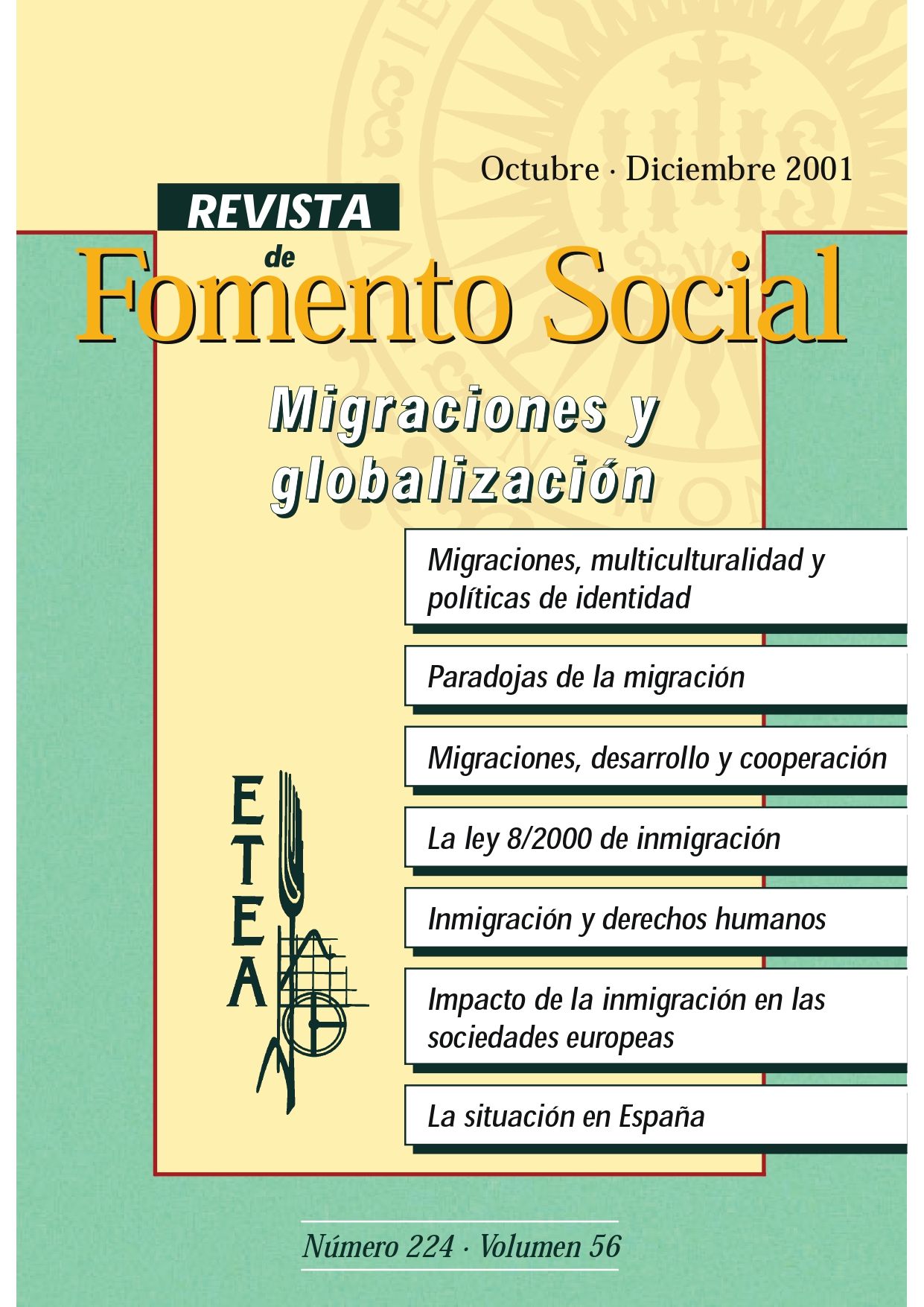
The 8/2000 Law, a law for integration of immigrants?
Article Sidebar
Main Article Content
Abstract
In this article legal precedents under current legislation on immigration matters form the basis for a critical analysis. The authors consider that the 8/ 2000 Law is not appropriate –the reasons given for its promulgation do not appear to be acceptable– nor are many of the solutions adopted acceptable either: the restrictions established regarding certain fundamental rights of immigrants, the treatment dispensed to family regrouping, legal guarantees established for immigrants etc. Unfortunately, the regulations developed by the Law are even more restrictive. For these reasons the conclusion to be reached could not be more disheartening: “Immigration policy in this country continues to be based exclusively on a system of closed borders and control of immigrant flow. With these ingredients it will be very difficult to reach a global solution for the immigration problem”.
Downloads
Article Details
The authors acknowledge that the Revista de Fomento Social assumes as its own the intellectual property rights over their work and grant the journal the permissions of distribution and public communication of the same established in the Berlin, Bethesda and Budapest declarations; for this reason they accept that the work presented be distributed in open access, protecting the copyright under a "Creative Commons Attribution-NonCommercial-NoDerivativeWorks 4.0 (CC BY-NC-ND) license.

You may copy, use, disseminate, transmit and publicly display provided that:
Cite the authorship of the work, the publication in Revista de Fomento Social, issue, year and the pages where you found the information.
No commercial benefit may be obtained.
No derivative works may be made for commercial purposes that are not authorized by the journal.
Authors are encouraged to disseminate the article electronically (Revista de Fomento Social, number, year, pagination, ISSN, DOI, etc.), in order to favor its circulation and diffusion, increase its citation and reach among the academic community.
The information of the journal will be provided to Dulcinea