
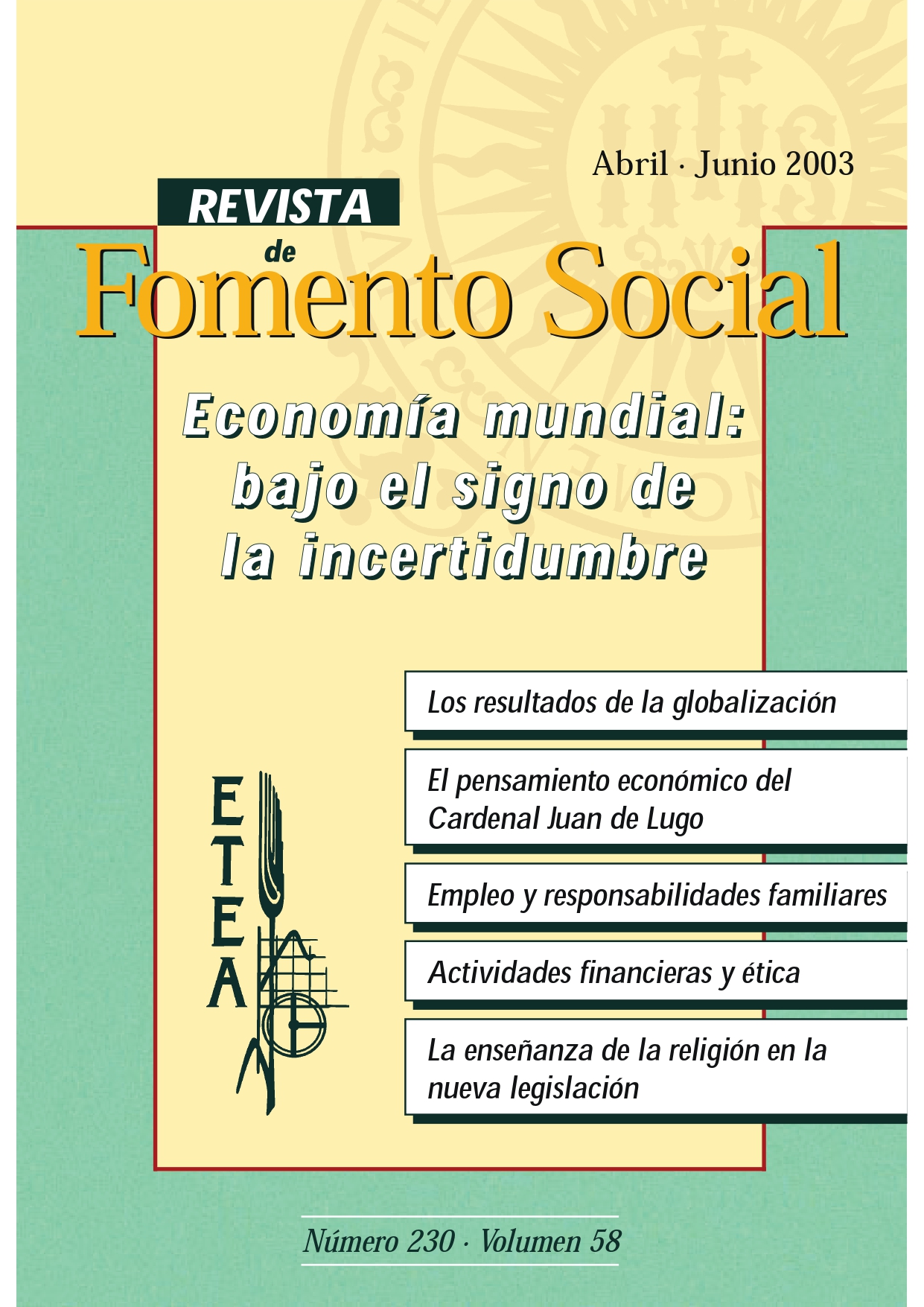
An approach to economic thinking by late scholasticism through cardinal Juan de Lugo SJ.
Article Sidebar
Main Article Content
Abstract
This study centres on the economic thinking of the XVII century Spanish scholastic Juan de Lugo – Doctor Hispalensis – and his theories on fair pricing, money and interest. The Fair Pricing theory revolves around five different elements: justice, subjective theory of value, common estimate, legal and natural prices and restitution. Together they make up a coherent total concept for an explicative pricing theory.
As far as financial thinking is concerned, the twin concept of money is reflected, both as simple cash and as capital (market tool). The problem of the twin concept of coins is also analysed: natural (quantity and quality of the metal itself) and legal (minting).
Regarding the analysis of usury, it sets out the main arguments put forward by Juan de Lugo to condemn it. These arguments do not stem from an a priori moral assumption, but from the scholastic view of natural right and the concept of money, time and the loan contract or mutuum.
Downloads
Article Details
The authors acknowledge that the Revista de Fomento Social assumes as its own the intellectual property rights over their work and grant the journal the permissions of distribution and public communication of the same established in the Berlin, Bethesda and Budapest declarations; for this reason they accept that the work presented be distributed in open access, protecting the copyright under a "Creative Commons Attribution-NonCommercial-NoDerivativeWorks 4.0 (CC BY-NC-ND) license.

You may copy, use, disseminate, transmit and publicly display provided that:
Cite the authorship of the work, the publication in Revista de Fomento Social, issue, year and the pages where you found the information.
No commercial benefit may be obtained.
No derivative works may be made for commercial purposes that are not authorized by the journal.
Authors are encouraged to disseminate the article electronically (Revista de Fomento Social, number, year, pagination, ISSN, DOI, etc.), in order to favor its circulation and diffusion, increase its citation and reach among the academic community.
The information of the journal will be provided to Dulcinea
References
CLAVERO, B., (1984): Usura: del uso económico de la religión en la historia, Madrid, Tecnos.
DEMPSEY, B. W., (1948): Interest and Usury, Londres, Dennis Dobson Ltd.
FUENTES QUINTANA, E., (dir.), (1999): Economía y economistas españoles, Vol. II, Barcelona, Galaxia Gutenberg–Círculo de Lectores.
LANGHOLM, O., (1979): Price and value in the Aristotelian tradition, Bergen, Universitetsforlaget.
—, (1982): “Economic freedom in scholastic thought”, en History of Political Economy, Vol 14, nº 2, pp. 260–283.
—, (1984): The Aristotelian analisys of usury, Oslo, Universitetsforlaget.
*—, (1998): The legacy of scholasticism in economic thought: Antecedents of choice and power, Cambridge, Cambridge University Press.
LUGO, J. DE, (1868): De iustitia et iure, en VIVÉS, L., (ed.), Disputationes scholasticae et morales, TT. VI y VII, París.
GÓMEZ CAMACHO, F., (1992): “Introducción” a Melchor de Soria: Tratado sobre la justificación y conveniencia de la Tassa de el pan, Madrid, Fundación Banco
exterior, pp. 7–57.
*—, (1998a): Economía y filosofía moral: La formación del pensamiento económico europeo en la Escolástica española, Madrid, Síntesis.
—, (1998b): «Later scholastics: spanish economic thought in the XVITH and XVIITH centuries», en Ancient and medieval economic ideas and concepts of social
justice, LOWRY, S. T. & GORDON, B., (eds.), Leiden–New York–Köln, Brill, pp. 503–560.
GÓMEZ CAMACHO, F. y ROBLEDO, R., (eds.), (1998): El pensamiento económico en la Escuela de Salamanca, Salamanca, Ediciones Universidad de Salamanca.
*GRICE–HUTCHISON, M., (1982): El pensamiento económico en España: 1177– 1740, Barcelona, Crítica.
—, (1993): Economic thought in spain: Selected essays of Marjorie Grice– Hutchison, Cambridge, Edward Elgar Publishing.
HICKS, J., (1979): Causality in Economics, Oxford, Basill Blackwell.
HUERTA DE SOTO, J., (2000): La escuela austriaca. Mercado y competitividad empresarial, Madrid, Síntesis.
MOLINA, L. DE,, (1981): La teoría del justo precio, Madrid, Nacional. [Edición moderna de F. Gómez Camacho.]
—, (1989): Tratado sobre los préstamos y la usura, Madrid, Instituto de Estudios Fiscales. [Edición moderna de F. Gómez Camacho.]
—, (1991): Tratado sobre los cambios, Madrid, Instituto de Estudios Fiscales. [Edición moderna de F. Gómez Camacho.]
NAREDO, J. M., (1996): La economía en evolución: Historia y perspectivas de las categorías básicas del pensamiento económico, Madrid, Siglo XXI, 2ª ed.
NOONAN, J. T., (1957): The scholastic analysis of usury, Cambridge, Harvard University Press.
PRIBRAM, K., (1983): A history of economic reasoning, Baltimore, Johns Hopkins University Press.
*ROOVER, R. DE, (1971): Le pensée économique des scholastiques: doctrines et Méthodes, Montreal–París, Institutes d´études mediévales–J.Vrin.
—, (1974): Business, banking and economic thought in late medieval and early modern europe, Chicago, University of Chicago Press.
ROTHBARD, M., (1999): Historia del Pensamiento Económico: El pensamiento económico hasta Adam Smith, Vol. I, Madrid, Unión Editorial.
*SCHUMPETER, J.A., (1994): Historia del análisis económico, Barcelona, Ariel. [Versión castellana de History of economic analysis, Oxford University Pres, Inc., 1954.]
SIERRA BRAVO, R., (1975): El pensamiento social y económico de la escolástica: desde sus orígenes al catolicismo social, 2. Vols, Madrid, Consejo Superior de Investigaciones Científicas.
SMITH, A., (1999): Investigación sobre la naturaleza y causa de la riqueza de las naciones, folio, Barcelona. [Versión castellana de The Wealth of Nations, 1776.]
SORIA, M. DE,, (1992): Tratado de la justificación y conveniencia de la tassa de el pan, Toledo, 1633. [Edición Moderna de F. Gómez Camacho, Madrid, Fundación Banco Exterior, 1992.]
VIGO, A. DEL,, (1979): «La teoría del justo precio corriente en los moralistas españoles del siglo de oro», en Burgense, nº 20, 1979, pp. 57–130.
—, (1997): Cambistas, mercaderes y banqueros en el siglo de oro español, Madrid, B.A.C.
VILAR, P., (1978): Oro y moneda en la historia: 1450–1920, Barcelona, Ariel.