
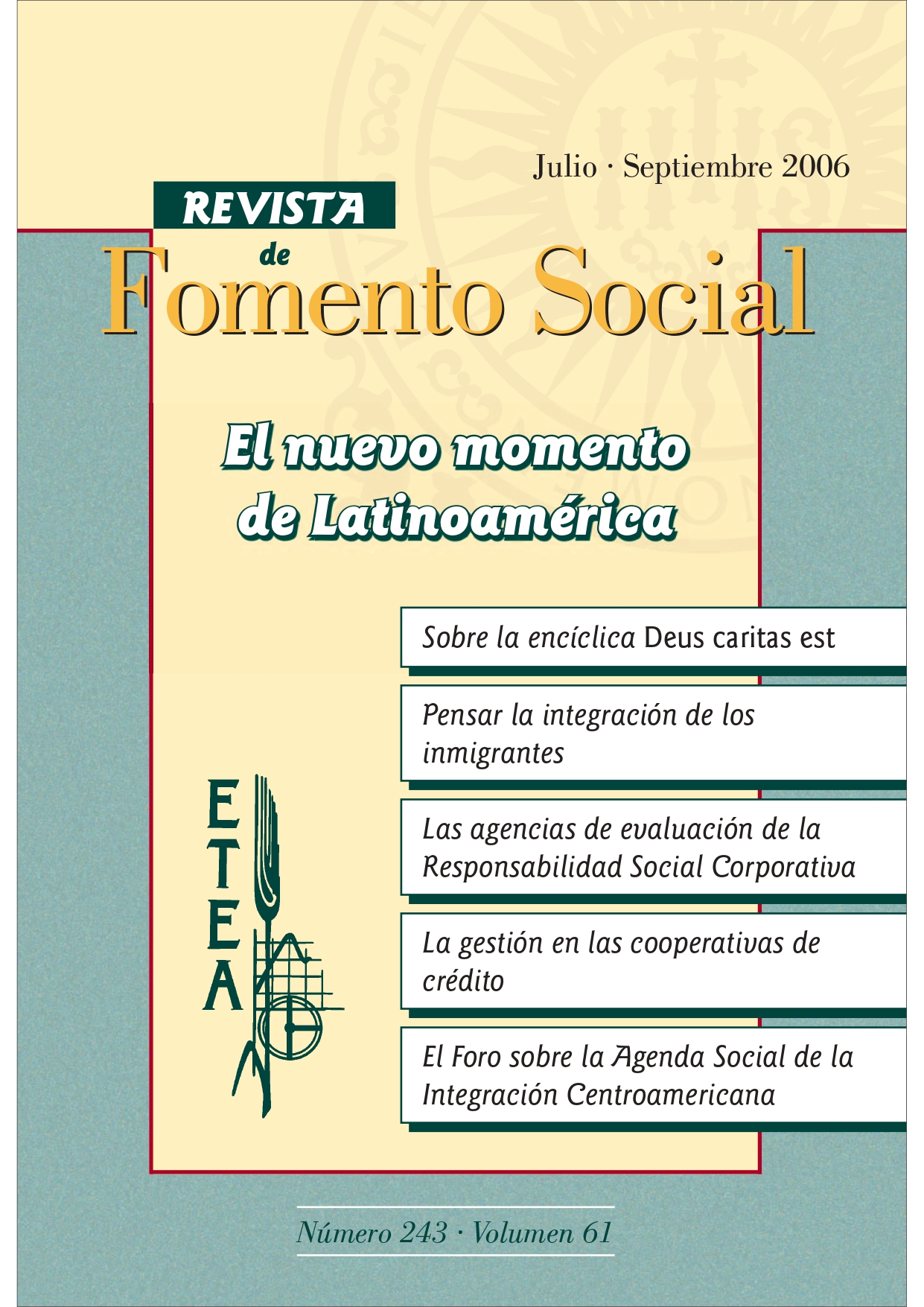
The new moment for Latinamerica
Article Sidebar
Main Article Content
Abstract
The reflection we propose begins with a brief revision of recent political changes that influence to a great extent the near future and development of Latin–American countries; that allows to understand the recent evolution of the economic situation of the region, whose most significant aspects are highlighted; follows a section dedicated to the debate on the processes of opening–up to new markets and of integration (understood in very different ways), in which an important part of their economic evolution is put at risk; the article finishes with a selection of lines in which some proposals nuclear for the future of the subcontinent are underlined: the first one refers to the need of profound reforms in taxation policy that make possible an approximation to the model called “Social State”; the second one has to do with the rural world, a sector of importance in these Latin–American countries, due to the great impact of poverty on it; finally, in the actual context of globalization, it is insisted on the processes of integration, understanding it beyond the mere “free market”, as a concept coherent with the model of development, that is not automatically identified with average economic growth.
Downloads
Article Details
The authors acknowledge that the Revista de Fomento Social assumes as its own the intellectual property rights over their work and grant the journal the permissions of distribution and public communication of the same established in the Berlin, Bethesda and Budapest declarations; for this reason they accept that the work presented be distributed in open access, protecting the copyright under a "Creative Commons Attribution-NonCommercial-NoDerivativeWorks 4.0 (CC BY-NC-ND) license.

You may copy, use, disseminate, transmit and publicly display provided that:
Cite the authorship of the work, the publication in Revista de Fomento Social, issue, year and the pages where you found the information.
No commercial benefit may be obtained.
No derivative works may be made for commercial purposes that are not authorized by the journal.
Authors are encouraged to disseminate the article electronically (Revista de Fomento Social, number, year, pagination, ISSN, DOI, etc.), in order to favor its circulation and diffusion, increase its citation and reach among the academic community.
The information of the journal will be provided to Dulcinea