
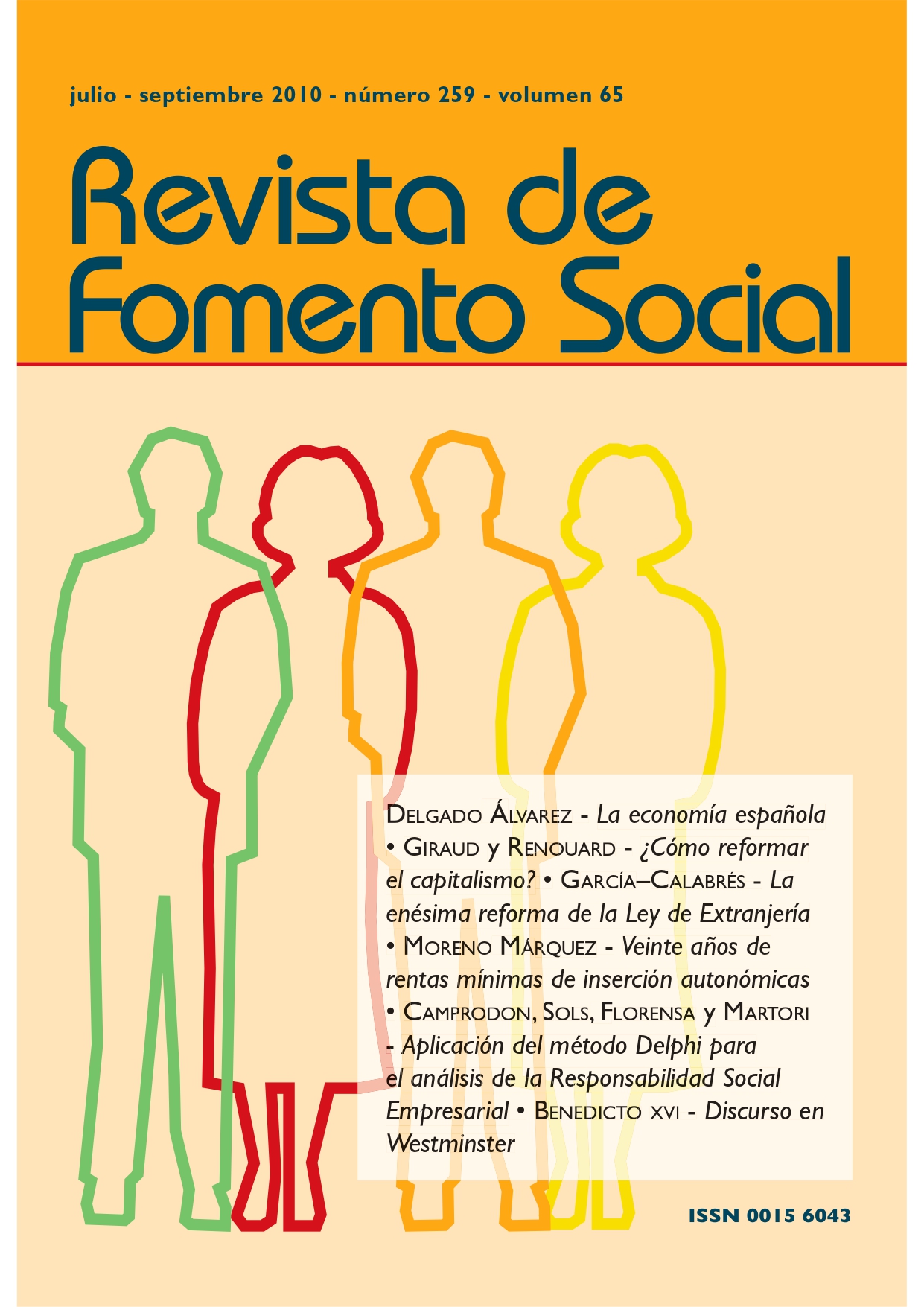
Twenty years of regional integration of minimum income: the Basque case in the Spanish and European context
Article Sidebar
Main Article Content
Abstract
In 1989 the first state minimum–income program was set into motion, the Basque Minimum Household Income, which was greatly influenced by the French Revenu Minimum d’Insertion (RMI). The development and evolution of different autonomous programs has resulted in a model of minimum income with certain peculiarities and distinguishing features. Among others, we can highlight the great heterogeneity and big differences that exist between the various programs. This article will analyse the state of affairs at state level as well as the main trends in Europe. It will also comment on the future of these policies in the European context which is placing great importance on activation, especially in the current context of economic crisis.
Downloads
Article Details
The authors acknowledge that the Revista de Fomento Social assumes as its own the intellectual property rights over their work and grant the journal the permissions of distribution and public communication of the same established in the Berlin, Bethesda and Budapest declarations; for this reason they accept that the work presented be distributed in open access, protecting the copyright under a "Creative Commons Attribution-NonCommercial-NoDerivativeWorks 4.0 (CC BY-NC-ND) license.

You may copy, use, disseminate, transmit and publicly display provided that:
Cite the authorship of the work, the publication in Revista de Fomento Social, issue, year and the pages where you found the information.
No commercial benefit may be obtained.
No derivative works may be made for commercial purposes that are not authorized by the journal.
Authors are encouraged to disseminate the article electronically (Revista de Fomento Social, number, year, pagination, ISSN, DOI, etc.), in order to favor its circulation and diffusion, increase its citation and reach among the academic community.
The information of the journal will be provided to Dulcinea
References
AGUIRRE, J. A. (1991) “Evaluación del primer año de implantación del ingreso mínimo familiar en el País Vasco”, VV.AA: IV Jornadas de Economía de los Servicios Sociales, Vitoria–Gasteiz, Gobierno Vasco.
ARRIBA, A. (1999) “Procesos de implantación de políticas de rentas mínimas de inserción en España”, Unidad de Políticas Comparadas (CSIC), Documento de Trabajo 99–09, en www.iesam.csic.es/doctrab1/dt–99–09.pdf
ARRIBA, A. y PÉREZ, B. (2007) “La última red de protección social en España: prestaciones asistenciales y su activación”, Política y Sociedad, vol. 44, nº 2, pp. 115–133.
ARRIBA, A.; PARRILLA, J. M. y PÉREZ, B. (2009) “Transformaciones de las políticas autonómicas de inclusión social”, I Congreso de la Red Española de Política Social, Oviedo, 5–7 de noviembre.
A. y ARRIBA, A. (2004) “Policy reforms and discourses in social assistance in teh 1990s: Towards Activation”, Paper presented at ESPAnet Annual Conference, September 9–11, Oxford, en www.iesam.csic.es/doctrab/dt0411.pdf
AVENEL, M. (2005) “Les modes d’organisation adoptés par les conseils généraux por la gestion du RMI suite à la décentralisation”, Études et Résultats, nº 432.
AYALA, L. (2000) Las Rentas Mínimas en la Reestructuración de los Estados de Bienestar, Madrid, Consejo Económico y Social.
BEHRENDT, C. (2003) “Programas de rentas mínimas y la reducción de la pobreza: ¿una red de seguridad defectuosa?, GUILLÉN, A. M. y ÁLVAREZ GARCÍA, S. (Coords.) Viejas y nuevas desigualdades: retos para la protección social, Madrid, Thomson–Civitas.
BERNAT, J. (2009) “La Renta de Solidaridad Activa en Francia. ¿Es la activación una vía para salir de la pobreza?”, Zerbitzuan, nº 45, junio, pp. 23–38.
BUSILACCHI, G. (2008) “The different regimes of minimum income policies in the enlarges Europe” en XII. International Congress of BIEN, Dublin, en www.basicincome.org/bien/pdf/dublin08/4cigianlucabusilacchibienlargedeurope.doc
CABASES, J. M. y MONTSERRAT, J. (1991) “Análisis económico de la implantación de la renta mínima garantizada”, VV.AA: IV Jornadas de Economía de los Servicios Sociales, Vitoria–Gasteiz, Gobierno Vasco.
CAPUCHA, L. (1998) Rendimento Mínimo Garantido: avaliaçao da fase experimental, Lisboa, CIES/MTS.
CASTEL, R. (1997) Las metamorfosis de la cuestión social. Una crónica del salariado, Buenos Aires, Paidós.
COMISIÓN EUROPEA (1993) Libro Verde. Política Social. Opciones para la Unión, Luxemburgo, Oficina de Publicaciones de la UE.
DAGUERRE, A. y ETHERINGTON, D. (2009) Active labour market policies in international context: What works best? Lessons of the UK, Londres, Department for Work and Pensions.
DA ROIT, B. y CREPALDI, CH. (2007) The role of minimum income for social inclusión in the European Union, Bruselas, European Parlament.
DE GRAAF, W.; FRERICKS, P. y MAIER, R. (2003) “Subsidied labour as a labour market strategy in European Countries”, Copenhague, ESPAnet Conference, en www.sfi.dk/graphics/ESPAnet/papers/graffmaier.pdf
DE KONING, J. y MOSLEY, H. (2002) “How can active policies be made more effective” en SCHMID, G. y GAZIER, B. (Eds.) The Dynamics of Full Employment: Social Integration through Transitional Labour Markets, Chentelham, Edgard Elgar.
DE GIORGI, G. y PELLIZZARI, M. (2006) “Welfare migration in Europe and the cost of a harrmmonised social assistance”, IZA Discusion Paper, nº 2.094, abril, en www.repec.iza.org/dp2094.pdf
EAPN (2005) “¿Puede contribuir la activación a la inclusión social? Criterios para una buena activación según EAPN”, en www.eapn.horus.be/.../images/pdf/pdf_publication/EAPN%20Publications/Traducs/Spanish/PP12–05%20Activation_es.pdf
EAPN (2006) “Ensuring a Decent Income and a Better Life for All” en www.eapn.horus.be…/images/pdf/pdf_publication/EAPN%20Publications/position/Minimum%20income_en.pdf
EAPN (2009) “EAPN appeal for Adequate Minimum Income for all: What EAPN want” en www.adequateincome.eu/doc/what_EAPN–Wants.pdf
ESPING–ANDERSEN, G. (1993) Los tres mundos del Estado de Bienestar, Valencia, Ed. Alfons el Mangnànim.
EUROPEAN COMISSION (2006) “Concerning a consultation on action at EU level to promote the active inclusion of the people furthest from the labour market”, en www.europa.eu.int/eur–lex/LexUriServ/LexUriServ.do?uri=COM:2006:0044:FIN:en.pdf
EUROPEAN COMISSION (2008) “Recommendation on the active inclusion of people excluded from the labour market”, Official Journal of The European Union, 18 de noviembre de 2008.
EUZÉBY, CH. (2004) “La activación francesa de las personas en situación de desempleo y de los beneficiarios de la asistencia pública: entre el workfare anglosajón y la inserción escandinava”, Encuentro Renta Básica y Procesos de Inserción, Vitoria–Gasteiz, en www.sergofi.com/gizarteratze/pdf/ponencias/Euzéby.pdf
EUZÉBY, CH. (2006) “Los ingresos mínimos no pueden resolver por sí solos el problema de la pobreza y la exclusión” (Entrevista), Hilero Eguneratuz, nº 65, mayo, pp. 8–10.
FRAZER, H. y MARLIER, E. (2009) Income Schemes Across EU Member States, European Comission, en www.ceps.eu/pdf/11/art1464.pdf
GARCÍA ROMERO; Mª B. (1999) Rentas Mínimas Garantizadas en la Unión Europea, Madrid, Consejo Económico y Social.
GAVIRIA, L. y GONZÁLEZ, F. (2002) “Propuestas integradas de políticas activas de bienestar y empleo: sumario”, en www.eurofound.eu.int/publications/files/EF0260ES.pdf
GOBIERNO VASCO (2008) Estudio de las personas perceptoras de Renta Básica. Vitoria–Gasteiz: Gobierno Vasco.
HANESCH, W. (2001) “Activation: Narratives and Realities. A Seven Countries ComParíson”, Paper presented at the ESA and STAKES Workshop Social Exclusion, minimum income support and workfare in Europe en www.shati.uniurb.it/eurex/ esa/PDF/ESA–Hanesch.pdf
HANESCH, W. y BALZTER, N. (2001) “Activation Policies in the Context of Social Assistance”, National Research and Development Centre for Welfare and Health, en www.stakes.fi/verkkojulk/pdf/SoccasstReport4.pdf
HIRSCH, M. (2006) La pauvreté en heritage, París, Robert Lafont.
HVINDEN, B. (1999) “Activation: a Nordic Perspective” en European Foundation for the Improvement of Living and Working Conditions: Linking Welfare and Work, Luxemburgo, Office for Official Publications of the European Communities.
KAZEPOV, Y. y SABATINELLI, S. (2005) “The Belgium Droits à l´integration sociale (DIS) in a European perspective”, Peer Review Meeting, Brussels, en www.peer–review-social–inclusion.net/peer/pdf_pool/05_BE_short_en_051114.pdf
KLUVE, J. (2006) The Effectiveness of European Active Labour Market Policy, Bonn, Institute for the Study of Labour.
LAPARRA, M. (2004) “La travesía del desierto de las rentas mínimas en España”, Documentación Social, nº 135, octubre–diciembre, pp. 57–76.
LAPARRA, M. (2004) “Las Rentas Mínimas en España”, Encuentro Renta Básica y Procesos de Inserción, 1–2 diciembre, Vitoria–Gasteiz.
LAPARRA, M. y AYALA, L. (2009) El sistema de garantía de ingresos mínimos en España y la respuesta urgente que requiere la crisis social, Madrid, Fundación Foessa.
L‘HORTY, Y. (2006) “La opinión de los franceses sobre el RMI se ha vuelto mayoritariamente negativa en los últimos años” (Entrevista), Hilero Eguneratuz, nº 63, marzo, pp. 7–8.
MANDIN, CH. y PALIER, B. (2003) “Policy Maps. France”, en www.kent.ac.uk/wramsoc/workinpapers/secondyearsreport/policymaps/francepolicymaps.pdf
MEGHIR, C. (2008) “Lessons from the Evaluation of Laboru Market Policies”, Standform Center for International Development annual Indico Conference, 5–6 junio.
MORENO, G. (2008) “La reforma del bienestar en los países anglosajones: una revisión crítica del workfare”, Servicios Sociales y Política Social, nº 81, pp. 151–166.
MORENO, L. (2000) Ciudadanos precarios. La “última red” de protección social, Barcelona, Ariel.
MORENO, L.; MATSAGANIS, M.; FERRERA, M.; CAPUCHA, L. (2003) “Existe una malla de seguridad en la Europa del sur”, Documento de Trabajo, 03–1, CSIC, en www.iesam.csic.es/doctrab2/dt–0317.pdf
MTAS (2005) “III Plan Nacional de Acción para la Inclusión Social del Reino de España. 2005–2006”, en www.mtas.es/SGAS/ServiciosSocDep/inclusionsocial/
plannacional/IIIPNAin.pdf
NICAISE, I. y MEINEMA, T. (2004) “Experiments in Social Activation in the Netherlands”, Sintesis Report of the Peer Review Meeting, en www.europa.eu.int/comm/employment_social_inclusion/docs/2005/pr_nl_en.pdf
NICAISE, I.; GROENEZ, S.; ADELMAN, L.; ROBERTS, S.; MIDDLETON, S. (2004) “Gaps, traps and springboards in the floor of social protection systems. A comparative study of 13
EU countries”, en www.sidos.ch/method/RC28/abstracts/Ides%20Nicaise.pdf
PEÑA–CASAS, R. (2005) “Guaranteed Minimum Income Schemes in EU”, en ww.eapn.ie/pdfs/155_RPC%20OSE%20paper%20202%20GMI%20schemes%20in%20EU%20version%205%20oct%2005.pdf
PÉREZ, B. (2004) “La activación como estrategia de lucha contra la exclusión social”, Documentación Social, nº 134, pp. 125–141.
— (2005) Políticas de activación y rentas mínimas, Madrid, Foessa.
— (2008) “Activation Policies and Minimum Income Schemes” en www.doku.iab.de/veranstaltungen/2008/activation_2008_eransus.pdf
ROBERTS, E. (2001) “Coordination of activation programmes for minimum income recipients. European experiences: a synthesis”, Paper presented in the Workshop Social Exclusion, minimum income support and workfare in Europe, en www.eurofound.eu.int/pubdocs/2000/74/en/1/ef0074en.pdf
SEILLIER, M. (2006) “Rapport sur le project de loi pour le retour à l´emploi et sur les droits et les devoirs des bénéficiaires de minima sociaux”, en www.senat.fr/rap/l05–161/l05–1611.pdf
SIIS (2002) “Dos de cada 100 familias vascas cobran la RB”, Hilero Eguneratuz, nº 19, febrero, p. 16.
SOCIAL PLATFORM (2006) “Achieving effective Minimum Income and Active Inclusion policies in the EU: What the European Union can contribute”, en www.socialplatform.org/module/FileLib/06–0455ResponseActiveInclusionFINALENpdf
UNIÓN EUROPEA (1992) “Recomendación 92/441/CEE del Consejo de 24 de junio de 1992, sobre los criterios comunes relativos a los recursos y prestaciones suficientes en los sistemas de protección social”, en www.europa.eu/scadplus/leg/es/cha/c10609.htm
URTEAGA, E. (2009) “Las políticas de lucha contra la pobreza y la exclusión social en Francia”, Zerbitzuan, nº 45, junio, pp. 7–21.