
Personal and contextual factors that make volunteer activities more compatible with working life: an empirical study
Article Sidebar
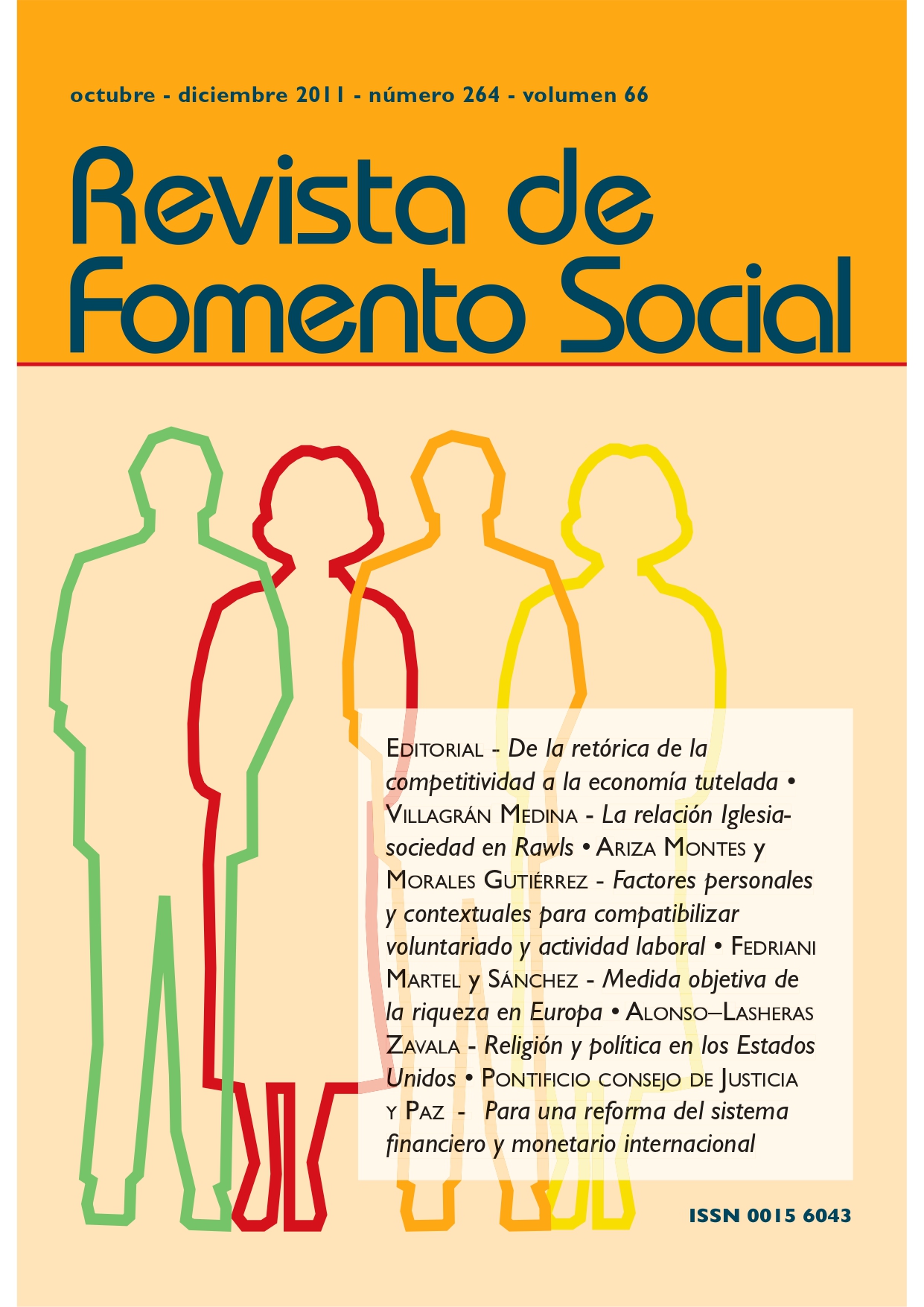
Main Article Content
Abstract
The purpose of this paper is to analyze the issues that determine the level of time employees devote to volunteer activities. A logistic–regression model has been applied –to a sample of 6334 employees– to evaluate how several categories of factors (personal, labour and organizational conditions, and involvement in the community) affect the amount of time dedicated to volunteer activities. The findings of this study are especially relevant in two areas: on the one hand, for designing a policy for corporate social responsibility that incorporates the figure of corporate volunteer while considering relevant factors; and on the other hand, to enable third sector organizations to broaden their perspective beyond the traditional volunteer profile.
Downloads
Article Details
The authors acknowledge that the Revista de Fomento Social assumes as its own the intellectual property rights over their work and grant the journal the permissions of distribution and public communication of the same established in the Berlin, Bethesda and Budapest declarations; for this reason they accept that the work presented be distributed in open access, protecting the copyright under a "Creative Commons Attribution-NonCommercial-NoDerivativeWorks 4.0 (CC BY-NC-ND) license.

You may copy, use, disseminate, transmit and publicly display provided that:
Cite the authorship of the work, the publication in Revista de Fomento Social, issue, year and the pages where you found the information.
No commercial benefit may be obtained.
No derivative works may be made for commercial purposes that are not authorized by the journal.
Authors are encouraged to disseminate the article electronically (Revista de Fomento Social, number, year, pagination, ISSN, DOI, etc.), in order to favor its circulation and diffusion, increase its citation and reach among the academic community.
The information of the journal will be provided to Dulcinea
References
BRADY, H.; VERBA, S. y SCHLOZMAN, K. L. (1995) “Beyond SES: a resource model of political participation”, American Political Science Review, 89, 269–95.
BRADY, H.; SCHLOZMAN, K. L. y VERBA, S. (1999) “Prospecting for participants: rational expectations and the recruitment of political activists”, American Political Science Review Review, 93, 153–69.
BREHM, J. y WENDY, R. (1997) “Individual–Level Evidence for the Causes and Consequences of Social Capital”, American Journal of Political Science, 41, 3 (July), 999–1023.
CABLE, S. (1992) “Women’s Social Movement Involvement: The Role of Structural Availability in Recruitment and Participation Process”, Sociological Quarterly, 33, 35–51.
CAPPELLARI, L. y TURATI, G. (2004) “Volunteer Labour Supply: The Role of Workers´ Motivations”, Annals of Public and Coopertive Economics, 75, 4.
CARO, F. y BASS, S. (1995) “Increasing volunteering among older people”. In Older and Active: How Americans Over 55 AreContributing to Society, ed. S.Bass, 71–96, New Haven, CT, Yale Univ. Press.
CARO, F. y BASS, S. (1997) “Receptivity to volunteering in the immediate post– retirement period”, Journal of Applied Gerontology, 16, 427–42.
CLARY, E.; SNYDER, M. y STUKAS, A. (1996) “Volunteers’ Motivations: Findings from a National Survey”, Nonprofit and Voluntary Sector Quarterly, 25, 485–505.
CNAAN, R. A. y ROBIN S. GOLDBERG–GLEN (1991) “Measuring Motivation to Volunteer in Human Services”, The Journal of Applied Behavioral Science, 27, 3, 269–284.
DAY, K. M. y DEVLIN, R. A. (1996) “Volunteerism and crowding out: Canadian econometric evidence”, Canadian Journal of Econometrics, 29 (1), 37–53.
DOWLING, W. (1997) “Voluntarism Among Older Women”, In J. Coyle (ed.), Han dbook on Women and Aging, Westport, Conn, Greenwood Press.
EAGLY, A. H. y STEFFEN, V. J. (1984) “Gender Stereotypes Stem from the Distribution of Women and Men into Social Roles”, Journal of Personality and Social Psichology, 46, 735–754.
FESHBACH, N. D. (1982) “Sex Differences in Empathy and Social Behavior in Children”, In N. Eisenberg (ed.), The Development of Prosocial Behavior, Orlando, Fla., Academic Press.
FISCHER, K., RAPKIN, B. y RAPPAPORT, J. (1991) “Gender and work history in the placement and perception of elder community volunteers”, Psychology of Women Quarterly, 15, 261–279.
FREEMAN, R. (1997) “Working for nothing: the supply of volunteer labor”, Journal of Labor Economics, 15, 140–167.
GALLAGHER, S. (1994) “Doing their share: comparing patterns of help given by older and younger adults”, Journal of Marriage and Family, 56, 567–578.
GASKIN, K. y SMITH, J. (1997) A New Civic Europe? A study of the Extent and Role of Volunteering, London, Natl. Cent. For Volun.
GILLIGAN, C. y ATTANUCCI, J. (1988) “Two Moral Orientations: Gender Differences and Similarities”, Merrill-Palmer Quarterly, 34, 223–237.
GILLIGAN, C. (1982) In a Different Voice: Psichological Theory and Women´```'s development. Cambridge, Mass., Harvard University Press.
GLASS, T.; SEEMAN, T.; HERZOG, A.; KAHN, R. y BERKMAN, L. (1995) “Change in productive activities in late adulthood”, Journal of Gerontology 50, 565–76.
GOMEZ, R. y GUNDERSON, M. (2003) “Volunteer Activity and the Demands of Work and Family”, Industrial Relations, 58, 4, 573–89.
GRØNBJERG, K. A. y NEVER B. (2004) “Role of Religious Networks and Other Factors in Different Types of Volunteer Work”, Nonprofit Management and Leadership, 14, 263–90.
GROSS, H. (1980) “Dual career couples who live appart: two types”, Journal of Marriage and the Family, 42, 567–76.
GUTERBOCK, T. M. y FRIES, J. C. (1997) “America’s Social Fabric ~ A Status Report” ~. AARP’s Webplace. [Online]. Available: http://research.aarp.org/general/ civic_prn.html [2002, November 22].
HALL, M.; KNIGHTON, T.; REED, P.; BUSSIERE, P.; MACRAE, D. y BOWEN, P. (1998) Caring Canadians, Involved Canadians, Ottowa, Statistics Canada.
HALL, M.; MCKEOWN, L. y ROBERTS, K. (2001) Caring Canadians: Highlight from the 2000 National Survey of Giving, Voluntering and Participating. Catalogue no. 71–542–XIE, Ottawa, Statistics Canada.
HERZOG, A. y MORGAN, J. (1993) “Formal volunteer work among older Americans”, In Achieving a Productive Aging Society, ed. S. Bass, F. Caro, Y. Chen, 119–142, Westport CT, Auburn House.
HERZOG, A.; KAHN, R. y MORGAN, J. (1989) “Age differences in productive activity”, The Journal of Gerontology, 4, 129–38.
HODGKINSON, V. y WEITZMAN, M. con ABRAHAMS, J., CRUTCHFIELD, E. y STEVENSON, D. (1996) The nonprofit almanac 1996-1997: Dimensions of the independel¡nt sector, San Francisco, Jossey–Bass.
HOFFMAN, M. L. (1977) “Sex Differences in Empathy and Related Behaviors”, Psychological Bulletin, 84, 712–20.
HOUGLAND, J. y SHEPARD, J. (1985) “Voluntarism and the Manager: The Impact of Structural Pressure and Personal Interest on Community Participation”, Journal of Voluntary Action Research, 14, 65–78.
HOUSE, J. S. (1981) “Social Structure and Personality”, In Social Psychology, ed. By Morris Rosenberg y Ralph H. Turner, Basic Books.
GARCÍA, I. y MARCUELLO, C. (2007) “Social capital and participation in Nonprofit Organizations”, Nonprofit and Voluntary Sector Quarterly, 36, 1, 100–20.
GARCÍA, I. (1997) “La Ley del voluntariado y la “privatización” de la prestación social sustitutoria”, Revista de Fomento Social, 206, 237–47.
INDEPENDENT SECTOR (1999) “Giving and Volunteering in the United States: Executive summary from a national survey”, Internet: www.independetsector.org/GandV/default.htm (accessed March 25, 2003).
INSTITUTO NACIONAL DE ESTADÍSTICA (2004) Encuesta de empleo del tiempo 2002-2003, Madrid, INE.
KINCADE, J.; RABINER, D.; SHULARNIT, B. y WOOMERT, A. (1996) “Older adults as a community resource: results from the National Survey of Self–Care and Aging”, , 36, 474–82.
LYONS, N. P. (1983) “Two Perspectivas: On Self Relationships, and Morality”, Harvard Educational Review, 53, 125–45.
MARCUELLO, C. (2001) “Trabajo no remunerado: la aportación de trabajo voluntario a las Organizaciones No Lucrativas en un contexto familiar”, Cuadernos de Economía y Dirección de la Empresa, 10, 381–96.
MCPHERSON, J. y ROTOLO, T. (1996) “Diversity and change in voluntary groups”, American Sociology Review, 61, 179–202.
MCPHERSON, J. (1981) “A Dynamic Model of Voluntary Affiliation”, Social Forces, 59, 705–28.
MENCHIK, P. L. y WEISBROD, B. A. (1987) “Volunteer labor supply”, Journal of Public Economics, Elsevier, 32 (2), 159–83.
MESCH, D. J.; ROONEY, P. M.; CHIN, W. y STEINBERG, K. S. (2002) “Race and gender differences in philanthropy: Indiana as a test case”, New Directions for Philanthropic Fundraising, 37, 65–77.
MIDLARSKY, E. y KAHANA, E. (1994) Altruism in Later Life, Thousand Oaks, CA, Sage.
MUSICK, M.; WILSON, J. y BYNUM, W. (2000) “Race and formal volunteering: the differential effects of class and religion”, Social Forces, 78 (4), 1539–1571.
NATIONAL ASSOCIATION OF SECRETARIES OF STATE (1999) New Millenium Project-Phase 1: a Nationwide Study of 15-24 Years Old Youth, Washington, Nat. Assoc. Secretaries of State.
O´NEILL, M. y ROBERTS, W. (1999) “Giving and Volunteering in California”, Paper presented at ARNOVA conference, Washington, D.C..
OKUN, M.; BARR, A. y HERZOG, A. (1998) “Motivation to volunteer by older adults: a test of competing measurement models”, Psychology and Againg, 13, 608–17.
PEARCE, J. (1993) Volunteers: The Organizational Behavior of Unpaid Workers, Routledge.
PERKINS, K. (1990) “Volunteer fire and rescue departments: structure, process and survival”, Nonprofit and Voluntary Sector Quarterly, 19, 359–70.
PILIAVIN, J. A. y UNGER, R. K. (1985) “The Helpful But Helpless Female: Myth or Reality?”, In V. E. O’Leary, R. Unger, and B. S. Wallston (eds.), Women Gender, and Social Psychology, Mahwah, N.J., Erlbaum.
PUTNAM, R. (2000) Nueva York, Simon & Schuster.
RAPAPORT, R. y RAPAPORT, R. N. (1978) Working couples, Nueva York, Harper and Row.
RASKOFF, S. y SUNDEEN, R. (1995) “Trends in volunteering: An analysis of a decade", Paper presented at the annual meeting of Association for Research on Non–Profit Organizations and Voluntary Associations, Cleveland, Ohio.
ROSENTHAL, S.; FEIRING, C. y LEWIS, M. (1998) “Political Volunteering from Late Adolescence to Young Adulthood: Patterns and Predictions”, Journal of Social Issues, 54, 471–93.
SCHLOZMAN, D.; BURNS, N. y VERBA, S. (1994) “Gender and the Pathways to Partici“Gender and the Pathways to Participation: The Role of Resources”, Journal of Politics, 56, 963–90.
SCHOENBERG, S. (1980) “Some trends in the community participation of women in their neighborhoods”, Signs, 5, 261–68.
SCHWIRIAN, K. y HELFRICH, M. (1988) “Economic Role and Community Involvement of Business Executives”, Sociological Quarterly, 9, 64–72.
SEGAL, L. (1993) Four essays on the supply of volunteer labor and econometrics, Unpublished doc. Diss. Northwestern Univ., Evanston, Ill.
SMITH, D. (1994) “Determinants of voluntary association participation and volunteering”, Nonprofit and Voluntary Sector Quarterly, 23, 243–63.
SMITH, L. (1975) “Women as Volunteers: The Double Subsidy”, Journal of Volunteer Action Reserch, 4, 119–36.
SOKOLOWSKI, S. (1996) “Show me the way to the next worthy deed”, Voluntas, 7, 259–76.
STEPHAN, P. (1991) “Relationships among market work, work aspirations and volunteering: the case of retired women”, Nonprofit and Voluntary Sector Quarterly, 20, 225–36.
STUBBINGS, P. y HUMBLE, S. (1984) “Voluntary work, Unemployment and the Labour Market in Britain”, en Voluntary Work and Unemployment in the Countries of the European Communities, 1–63, Londres, Policy Studies Institute.
SUNDEEN, R. y RASKOFF, S. (1994) “Volunteering among teenagers in the United States”, Nonprofit and Voluntary Sector Quarterly, 23, 383–403.
THOMPSON, A. (1993) “Volunteers and their communities: a comparative analysis of firefighters”, Nonprofit and Voluntary Sector Quarterly, 22, 155–66.
— (1995) “The sexual division of leadership in volunteer emergency medical service squads”, Nonprofit Management and Leadership, 6, 55–66.
VAILLANCOURT, F. (1994) “To volunteer or not: Canada 1987”, Canadian Journal Economics, 27 (4), 813–26.
WEITZMAN, M. S.; JALANDONI, N. T.; LAMPKING, L. M. y POLLAK, T. H. (2002) The New Nonprofit Almanac and Desk Reference, San Francisco, Jossey Bass.
WHYTE, W. H. (1957) The Organization Man, Doubleday Anchor Books.
WILSON, J. (2000) “Volunteering”,Annual Review of Sociology,26, 215–40.
WILSON, J. y MUSICK, M. (1997) “Work and volunteering: the long arm of the job”, Social Forces, 76, 251–72.
WILTFANG, G. y MCADAM, D. (1991) “The costs and risks of social activism: a study of sanctuary movement activists”, Social Forces, 69, 987–1011.
WINNIFORD, J. C.; CARPENTER, D. S. y GRIDER, C. (1997) “Motivations of collage Student Volunteers: A Review”,NASPA Journal, 34 (2), 134–46.
WOLFF, N.; WEISBROD, B. y BIRD, E. (1993) “The supply of volunteer labor: the case of hospitals”, Nonprofit Management and Leadership, 4, 23–45.
WOODARD, M. (1987) “Voluntary association membership among Black Americans”, Sociological Quarterly, 23, 285–301.
WUTHNOW, R. (1995) Learning to Care, Nueva York, Oxford Univ. Press.
— (1998) Loose Connections: Joining Together in America's Fragmented Communities, Cambridge, Harvard Univ. Press.