
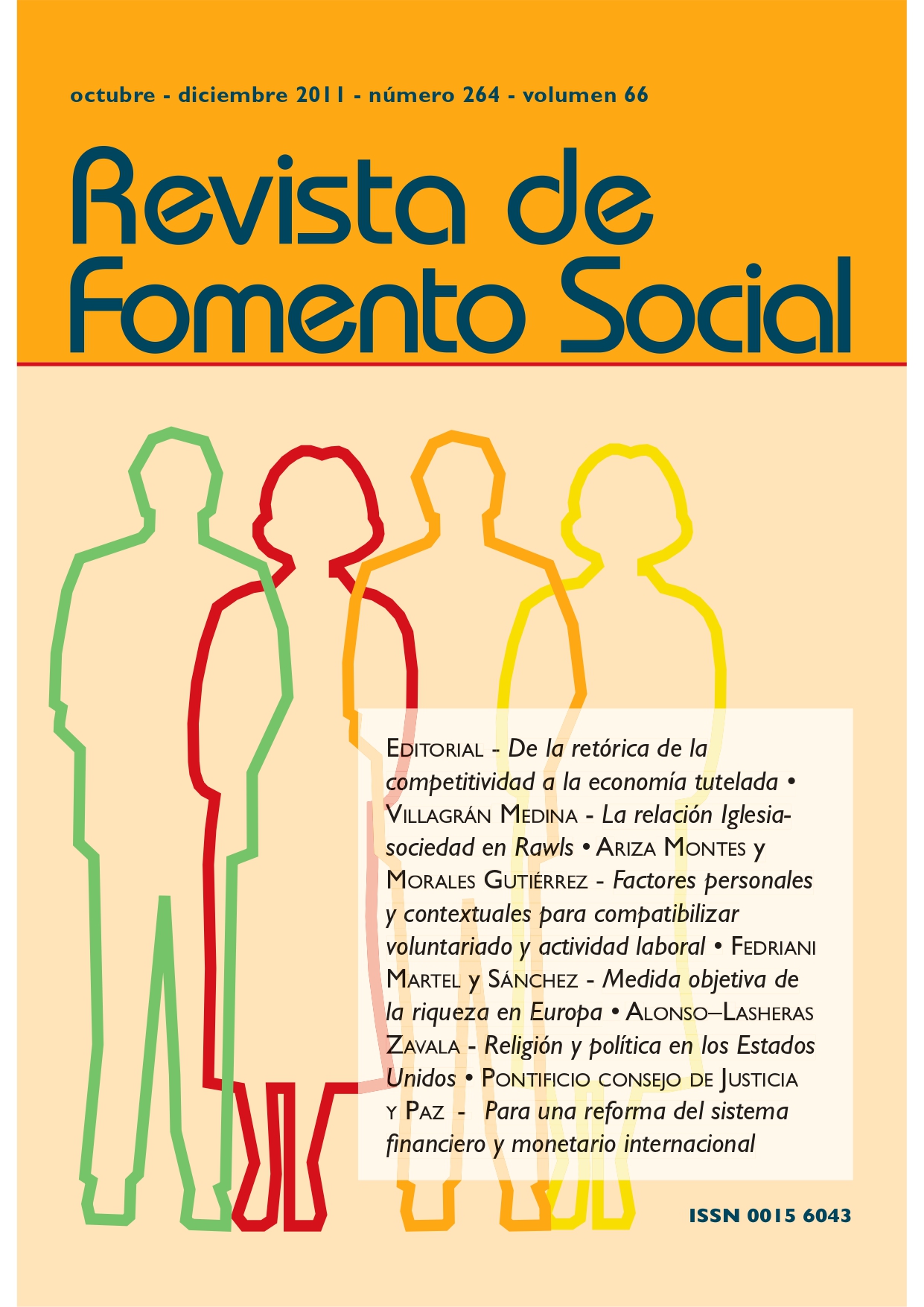
From the rhetoric of competitiveness to that of supervised economy: The political economy in Zapatero’s second term of government (2008–2011)
Article Sidebar
Main Article Content
Abstract
This is not our first commentary on the economic policy of a government at the end of its legislature. This last term ending in November of 2011 has continued in the same vein as previous ones, as well as showing a persistent decline in the Government’s expectations to propose an acceptable economic policy in its last term in power. Spain has experienced the supervision of its economy, although it has not had to undergo external intervention. Certainly, the economic policy of a State belonging to the Euro zone is very limited due to the sovereignty it has ceded; on the other hand, an economy like Spain’s, which is very open in its dealings abroad, has more difficulties implementing a vigorous, autonomous policy. The agenda of the new Government will undoubtedly include the administration of last summer’s constitutional reform which has made a priority of the policy of budgetary stability, but which cannot become a pretext for unsettling the constitutional economic system. This balance will not only demand a renewed constitutional consensus, but will also demand new economic governance in a global context. Our editorial places its best bet hereupon.
Downloads
Article Details
The authors acknowledge that the Revista de Fomento Social assumes as its own the intellectual property rights over their work and grant the journal the permissions of distribution and public communication of the same established in the Berlin, Bethesda and Budapest declarations; for this reason they accept that the work presented be distributed in open access, protecting the copyright under a "Creative Commons Attribution-NonCommercial-NoDerivativeWorks 4.0 (CC BY-NC-ND) license.

You may copy, use, disseminate, transmit and publicly display provided that:
Cite the authorship of the work, the publication in Revista de Fomento Social, issue, year and the pages where you found the information.
No commercial benefit may be obtained.
No derivative works may be made for commercial purposes that are not authorized by the journal.
Authors are encouraged to disseminate the article electronically (Revista de Fomento Social, number, year, pagination, ISSN, DOI, etc.), in order to favor its circulation and diffusion, increase its citation and reach among the academic community.
The information of the journal will be provided to Dulcinea