
The concept of business in the encyclical Caritas in Veritate: an approach from the Economy of Communion
Article Sidebar
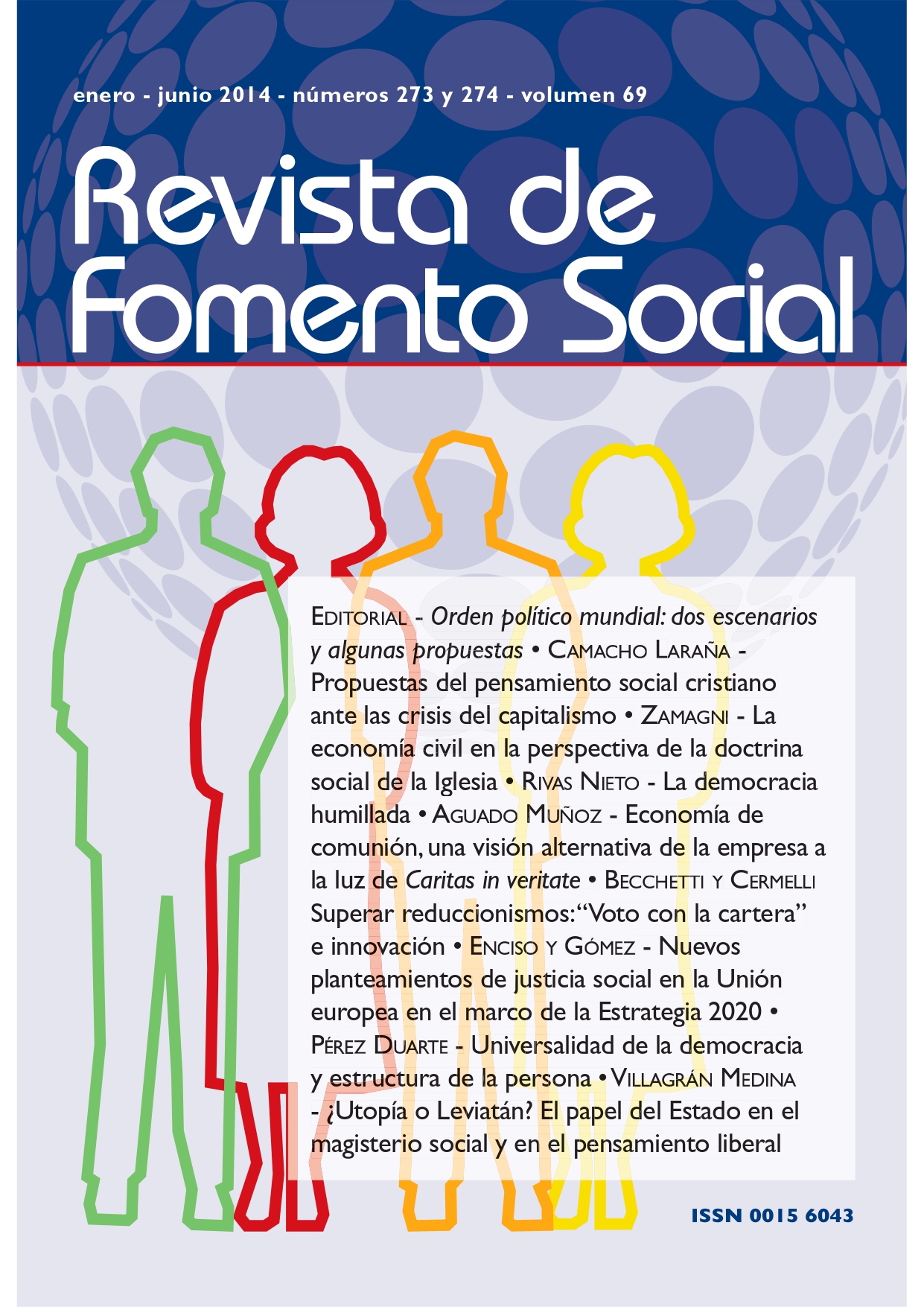
Main Article Content
Abstract
The social doctrine of the Church, from the Rerum Novarum of Leo XIII (1891) to the Caritas in Veritate of Benedict XVI (2009), has proposed a model of enterprise based on individual freedom for the implementation of entrepreneurship with social responsibility and respect for the environment. In this way, the main mission of the entrepreneur would be not on maximizing business benefit in any way, but to become an innovator that generates and promotes projects. Expressly, in the Encyclical Caritas in Veritate is encouraged to the entrepreneur go beyond the logic of profit, without renouncing it. Similarly, it gets highlighted the importance of the company as a valuable place of creativity and generation of jobs, wealth and new products and services. Additionally, the Encyclical states that the management of the company should respond not only to the interests of its owners, but also the interest of the set of subjects that relate to it (employees, customers, suppliers,...) and the interest of the social environment in which it is inserted, taking into account the environmental sustainability of that same environment. In this communication, in the first place, the basic principles on which the market economy currently sits will be presented. Secondly, shall be a brief overview of the main ideas of the Encyclical Caritas in Veritate on economic and business activity. Thirdly, it will introduce the idea of “economy of communion” and it will be analyzed in the light of the Encyclical Caritas in Veritate. The article closes with a section of conclusions.
Downloads
Article Details
The authors acknowledge that the Revista de Fomento Social assumes as its own the intellectual property rights over their work and grant the journal the permissions of distribution and public communication of the same established in the Berlin, Bethesda and Budapest declarations; for this reason they accept that the work presented be distributed in open access, protecting the copyright under a "Creative Commons Attribution-NonCommercial-NoDerivativeWorks 4.0 (CC BY-NC-ND) license.

You may copy, use, disseminate, transmit and publicly display provided that:
Cite the authorship of the work, the publication in Revista de Fomento Social, issue, year and the pages where you found the information.
No commercial benefit may be obtained.
No derivative works may be made for commercial purposes that are not authorized by the journal.
Authors are encouraged to disseminate the article electronically (Revista de Fomento Social, number, year, pagination, ISSN, DOI, etc.), in order to favor its circulation and diffusion, increase its citation and reach among the academic community.
The information of the journal will be provided to Dulcinea
References
Álvarez , M., Aguado , R. y Martínez , J. (2008): Estructura, Innovación y Crecimiento Económico. Bilbao, DDB.
Amann , W. et al. (2011): Business Schools under fire. Palgrave McMillan, Houndmills.
Barrenechea, J. M. (2011): “El análisis económico ortodoxo y sus límites” en santa C oloma , J. y ag U ado , R. (2011) (coords): Economía y Humanismo Cristiano (Una visión alternativa de la actividad económica). Serie Economía. Bilbao, Universidad de Deusto.
Benedicto XVI (2009): Caritas in veritate, disponible en http://www.papalencyclicals. net/all.htm (accedido 2 junio 2012).
Benioff , M. y so U thwiC k , k. (2004): Compassionate Capitalism. Career Press, Franklin Lakes, NJ.
Bruni, L. y Uelmen, A. (2006): “Religious values and corporate decision making: the economy of communion Project”. Fordham journal of corporate & financial law, Vol XI, pp. 645–680.
Bruni, L. y zamagni, S. (2004): “The Economy of Communion: Inspirations and Achievements” Finance & The Common Good/Bien Commun, nº 20, pp. 91–97.
Buckeye, J. G., gallag U er, J. B. y garlow , e. (2011): “Mundel&Associates, Inc.: Managing When Faith Really Matters”, Case Research Journal Volume 31, Issue 2, Spring 2011.
CMEPSP (2009): Report of the commission on the measurement of economic performance et social progress, September, 14, 2009, disponible en http://www. stiglitz–sen–fitoussi.fr/en/documents.htm (accedido 2 junio 2012).
Comisión interna C ional EdC (2011): General Guidelines for Operating an Economy of Communion Business, accessible en http://www.edc–online.org/en/publications/eoc–newsletter/n–28/516–le–nuove–linee–per–condurre–unimpresa–di– economia–di–comunione.html (acceso 5 julio 2012).
Cornwall , J. R. y na U ghton , M. J. (2003): “Who is the Good Entrepreneur? An Exploration within the Catholic Social Tradition”, Journal of Business Ethics 44 (1/2), pp. 61–75.
Elkington, J. (1998): Cannibals with Forks: the Thripple Bottom Line of 21st Century Business. (Gabriola Island, BC and Stony Creek, CT: New Society Publishers).
Escudero, M. (2011): “The future of Management Education: A Global Perspective”, en Amann, W. et al., (2011): Business Schools under fire. Palgrave McMillan, Houndmills.
European Commission (EC) (2009): General Report on the activities of the European Union. Bruselas, EC.
Ferrucci, A. (2011): “Veinte años de EdC: una historia de amor entre el cielño y la tierra” disponible en http://www.edc–online.org/es/publicaciones/ponencias– en–congresos/ (accedido 2 de junio 2012)
Fleurbaey, M. (2009): “Beyond GDP: The Quest for a Measure of Social Welfare”. Journal of Economic Literature, 47:4, pp. 1029–1075.
Frank , R. (2005): Microeconomía y conducta. Madrid, McGraw–Hill.
Freeman, E. et al. (2004): “Stakeholder Theory and the Corporate Objective Revisited”, Organization Science, 15(3), 364–9.
Friedman , M. (1970): “The social responsibility of a firm is to increase its profits”. Nueva York, New York Times Magazine.
Friendland , J. (ed) (2009): Doing well and good. The human face of the new capitalism. IAP, Charlotte.
Giraud S.I., G. y reno U ard , C. (2010): “¿Cómo reformar el capitalismo?” Revista de Fomento Social nº 259 (julio–septiembre), pp. 421–440.
Gold , L. (2010): New Financial Horizons. The Emergence of an Economy of Communion. Nueva York, New City Press.
Guibert, J. M. (ed.) (2009), Responsabilidad Social Empresarial. Competitividad y casos de buenas prácticas en pymes, San Sebastián, Universidad de Deusto.
Hamschmidt , J. y pirson , M. (2011): Case studies in social entrepreneurship and sustainability. Sheffield, Greenleaf Publishing.
IparragUirre, D. (1980): Lecciones de microeconomía teórica. Bilbao, Universidad de Deusto.
Jensen, M. C. (2001): “Value Maximization, Stakeholder Theory, and the Corporate Objective Function”, European Financial Management, 7 (3).
keay , A. (2007): “Tackling the Issue of the Corporate Objective: An Analysis of the United Kingdom’s Enlightened Shareholder Value Approach”, Sydney Law Review, 29(4).
kimakowitz et al. (2011): Humanistic Management in Practice. Hounmills, Palgrave McMillan.
León XIII (1881): Rerum novarum, disponible en http://www.papalencyclicals.net/ all.htm (accedido 2 de junio 2012).
Lubich, Ch. (2007): Essential Writings: Spirituality, Dialogue, Culture. Nueva York, New City Press.
Martínez , J. (2010): “El PIB (per cápita) como indicador de sostenibilidad”. Boletín de Estudios Económicos, Vol. 65, nº 200, pp. 283–308.
Marx, K. y engels , F. (1848): Manifesto of the Communist Party. Chicago, Charles Kerr.
mCCarthy, J. (2006): Catholic Social Teaching and Ecology Fact Sheet, available on http://ecojesuit.com/wp–content/uploads/2011/06/CST_ENG.pdf (acceso 5 julio 2012).
Mundel , J. A. (2011): “The Economy of Communion Business and Corporate Social Responsibility”. Conderencia desarrollada en el Congreso “The economy of communion and African economic vocation–theory and Best practice”, Nairobi (Kenya), Catholic University of Eastern Africa, enero, pp. 26–28.
Naughton , M. J. et al. (1995): “The Common Good and the Purpose of the Firm: A Critique of the Shareholder and Stakeholder Models from the Catholic Social Tradition”, Journal of Human Values, 1, pp. 221–37.
OECD (2008): Growing unequal? Income Distribution and Poverty in OECD countries. París, OECD.
Organización de las Naciones Unidas (UN) (2010): Summit on the Millennium Development Goals. Nueva York, UN.
Pirson , M. (2011): “What is business organized for? The role of business in society over time” en Amann, W. et al., (2011): Business Schools under fire. Houndmills, Palgrave McMillan.
Porter , M. E. y kramer , m. r. (2002): “The Competitive Advantage of Corporate Philanthropy”, Harvard Business Review, diciembre; 80(12): 56–68, 133.
Robbins, L. (1932): An Essay on the Nature and Significance of Economic Science, Londres, MacMillan and Co Ltd
Sagastagoitia, J. (2011): “Justicia económica: todas las personas tienen derecho a participar de la economía” en santa C oloma , J. y ag U ado , R. (2011) (coords): Economía y Humanismo Cristiano (Una visión alternativa de la actividad económica). Serie Economía. Bilbao, Universidad de Deusto.
Santacoloma , J. y ag U ado , R. (2011) (coords): Economía y Humanismo Cristiano (Una visión alternativa de la actividad económica). Serie Economía. Bilbao, Universidad de Deusto.
Smith , A. (1776): An inquiry into the nature and causes of the wealth of nations. Londres, Strahan y Cadell.
Stiglitz, J., sen, A. y fitoUssi, J.–P. (2009): The Measurement of Economic Performance and Social Progress Revisited – Reflections and Overview, septiembre, 16, disponible en http://www.stiglitz–sen–fitoussi.fr/en/documents.htm (accedido 12 de febrero 2012).
Stuart Mill, J. (1848): Principles of Political Economy with Some of Their Applications to Social Philosophy. Boston, Charles C. Little y James Brown.
Thatchenkery, T. et al. (2010): Positive design and Appreciative Construction: From Sustainable Development to Sustainable Value. Emerald Books, Bingley.
Uelmen, A. (2010): “Caritas in veritate and Chiara Lubich: human development from the vantage point of unity”. Theological studies 71, pp 29–45.
world Commission on environment and development (1987): From One Earth to One World: An Overview. Oxford, Oxford University Press.
World Economic Forum (WEF) (2011): The Global Competitiveness Report 2011–12. Génova, WEF.
Zamagni, S. (2002): “On the Foundation and Meaning of the ‘Economy of Communion’ experience” en br U ni, L. (ed) (2002): The Economy of Communion. Hyde Park, NY, New City Press.