
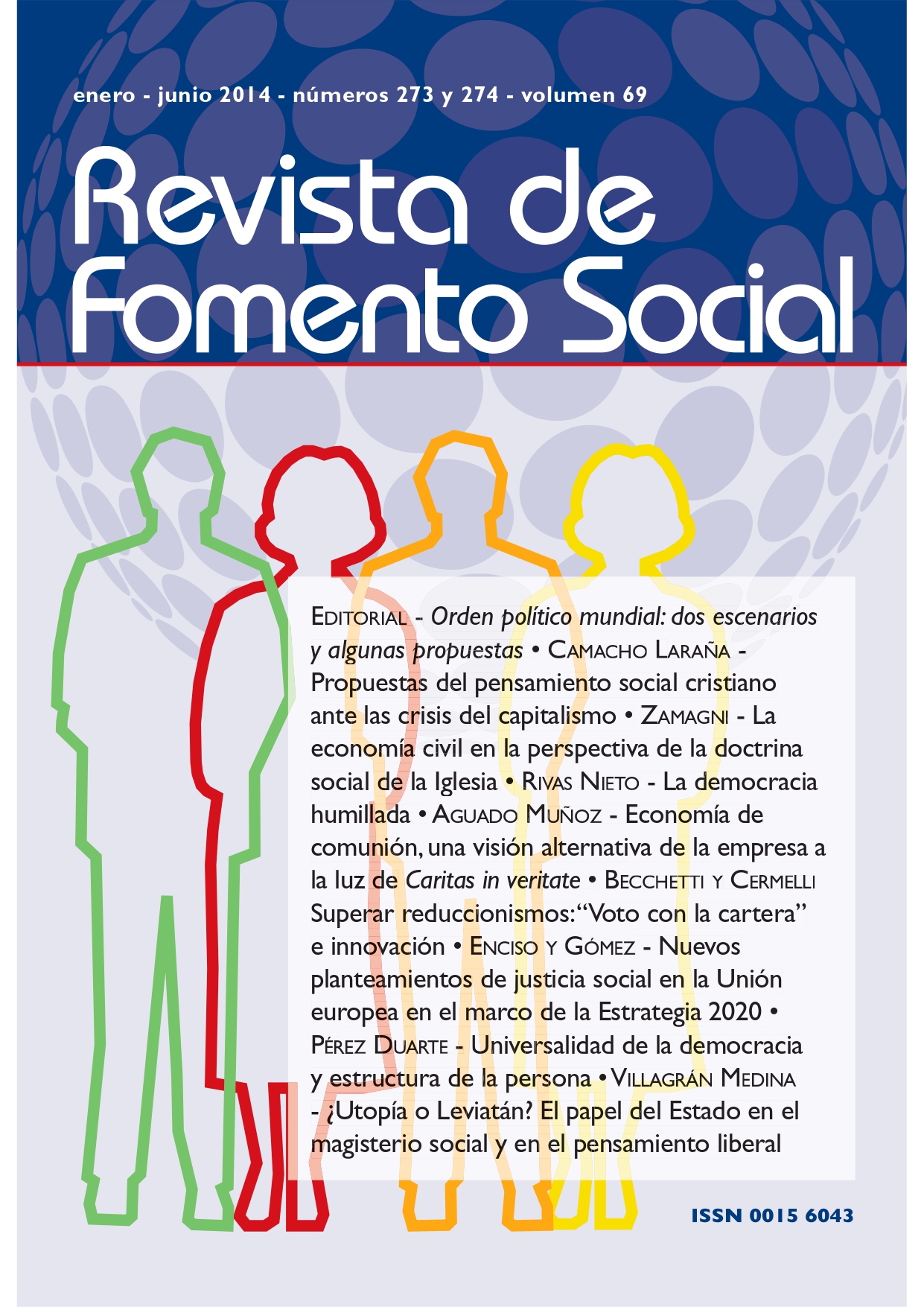
Historical proposals of Christian social teaching in times of economic crisis
Article Sidebar
Main Article Content
Abstract
The comparison between two major crises of contemporary capitalism allows the author to relate them to the corresponding positions that the Church, through its social doctrine. The 1929 crisis was reflected in the social encyclical of Pius XI, Quadragesimo anno (1931), while with Caritas in veritate (2009), Benedict XVI arrived on time to make some important observations about the financial crisis that began in 2007, although all its consequences were not so visible. The item could not reflect the social teaching of Francis, elected months earlier, in March 2013. The proposals of Caritas in veritate, underscores the required reconsideration on the nature of economic activity and a world public authority, already carried out by John XXIIII in 1963. Following two recent contributions of a Justice and Peace documents on the reform of the financial system and on the business leadership are presented. A concluding section summarizes the set of these propositions separated for nearly 80 years. The value proposition to address the crisis, especially the logic of gratuitousness underscored by Benedict XVI, may have an interesting influence, although not in the short term.
Downloads
Article Details
The authors acknowledge that the Revista de Fomento Social assumes as its own the intellectual property rights over their work and grant the journal the permissions of distribution and public communication of the same established in the Berlin, Bethesda and Budapest declarations; for this reason they accept that the work presented be distributed in open access, protecting the copyright under a "Creative Commons Attribution-NonCommercial-NoDerivativeWorks 4.0 (CC BY-NC-ND) license.

You may copy, use, disseminate, transmit and publicly display provided that:
Cite the authorship of the work, the publication in Revista de Fomento Social, issue, year and the pages where you found the information.
No commercial benefit may be obtained.
No derivative works may be made for commercial purposes that are not authorized by the journal.
Authors are encouraged to disseminate the article electronically (Revista de Fomento Social, number, year, pagination, ISSN, DOI, etc.), in order to favor its circulation and diffusion, increase its citation and reach among the academic community.
The information of the journal will be provided to Dulcinea