
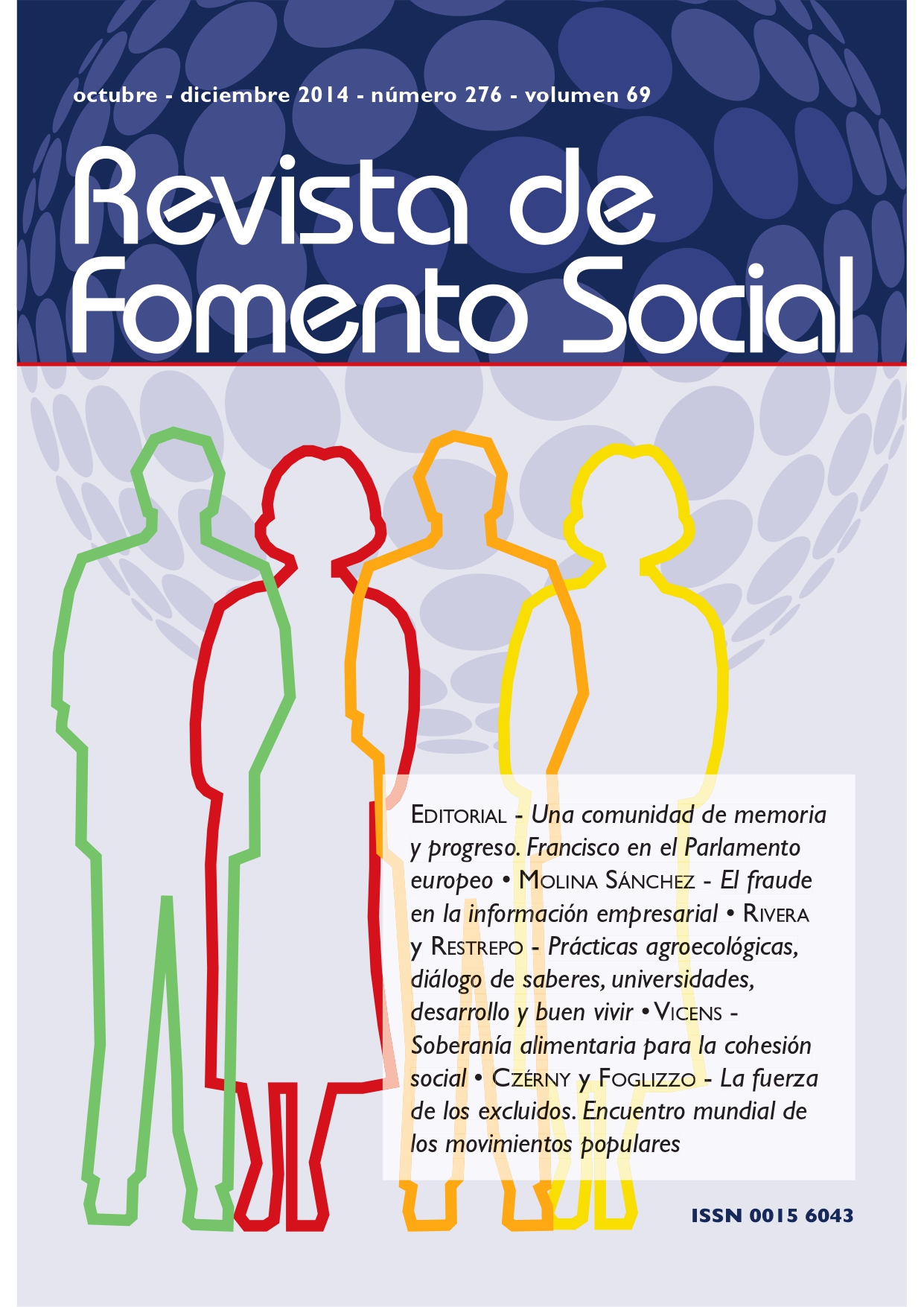
In the context of agro–ecological knowledge dialogue practices, universities, development and good living
Article Sidebar
Main Article Content
Abstract
In this paper, we start with the proposals of agroecology and its troubled relationship with sustainable development. In its classic form, agroecology form its foundations from a critical aspect that is articulated within the hegemonic university. From here derives the one hand a weak variation that develops with the entrenchment of it in its most instrumental forms, linked to corporate university. On the other hand, a radical aspect which, although it has a strong heritage in classical proposal consolidates, it is distinguished from it by establishing a form of “bottom–up” knowledge and in the process, creates his own university, intercultural university.
Downloads
Article Details
The authors acknowledge that the Revista de Fomento Social assumes as its own the intellectual property rights over their work and grant the journal the permissions of distribution and public communication of the same established in the Berlin, Bethesda and Budapest declarations; for this reason they accept that the work presented be distributed in open access, protecting the copyright under a "Creative Commons Attribution-NonCommercial-NoDerivativeWorks 4.0 (CC BY-NC-ND) license.

You may copy, use, disseminate, transmit and publicly display provided that:
Cite the authorship of the work, the publication in Revista de Fomento Social, issue, year and the pages where you found the information.
No commercial benefit may be obtained.
No derivative works may be made for commercial purposes that are not authorized by the journal.
Authors are encouraged to disseminate the article electronically (Revista de Fomento Social, number, year, pagination, ISSN, DOI, etc.), in order to favor its circulation and diffusion, increase its citation and reach among the academic community.
The information of the journal will be provided to Dulcinea
References
AGOSTINO, A. (2009) “Alternativas al desarrollo en América Latina: ¿qué pueden aportar las universidades?”, América Latina en Movimiento, 445, pp. 14–17
ALMEIDA, J. (2003) A Agroecología entre o Movimento Social e a Domesticação pelo Mercado. Ensaios da FEE. Fundação de Economia e Estatística Siegfried Emanuel Heuser, 24 (2), pp. 499–520. Porto Alegre
ALTIERI, M. (2009) “El estado del arte de la agroecología: revisando avances y desafíos”. En: ALTIERI, M. ed. Vertientes del pensamiento agroecológico. Fundamentos y aplicaciones, Medellín, SOCLA. Disponible en : www.agroeco.org/socla [Acceso: 19 de mayo de 2013].
ALTIERI, M & A. YURJEVICH. (1991) La Agroecología y el Desarrollo Rural Sostenible en América Latina. Revista de CLADES. Disponible en : http://www.clades.cl/ revistas/1/rev1art3.htm [Acceso: 19 de mayo de 2013].
BRETON, P. y LE BRETON, D. (2009) El silencio y la palabra contra los excesos de la comunicación. Buenos Aires, Ediciones Nueva Visión.
CASTRO, S. (2005) La poscolonialidad explicada a los niños. [En línea] Popayán: Universidad del Cáuca & instituto pensar de la Universidad Javeriana. Disponible en: http://www.cholonautas.edu.pe/modulos/biblioteca2.php?IdDocumento=0518 [Acceso: 15 de noviembre de 2009].
CORTEZ, D. (2009) (Manuscrito) Genealogía del “buen vivir” en la nueva constitución ecuatoriana. Ponencia presentada en el VIII International Congress for Intercultural Philosophy. Good life as humanized life. Concepts of good life in different cultures and their meanings for politics and societies today, Seoul, Ewha Womans University.
DÁVALOS, P. (2008) “Reflexiones sobre el sumak kawsay (el buen vivir) y las teorías del desarrollo”. Disponible en: América latina en movimiento http://alainet.org/ active/25617&lang=es [Acceso: 1 de mayo de 2013].
DUSSEL, E. (2001) “Etnocentrismo y modernidad: Introducción a las lecturas de Frankfurt”. En: W. MIGNOLO, ed. Cosmopolitismo y geopolítica del conocimiento: El eurocentrismo y la filosofía de la liberación en el debate intelectual contemporáneo. Buenos Aires, Ediciones del Signo, pp. 57–70.
ESCHENHAGEN, M. (2007) “La educación ambiental superior en América Latina: una evaluación de la oferta de posgrados ambientales”. THEOMAI, 16, pp. 87–107.
ESCOBAR, A. (2005) “El postdesarrollo como concepto y práctica social”. En: MATO D. coord. Políticas de economía, ambiente y sociedad en tiempos de globalización. Caracas, Facultad de Ciencias Económicas y Sociales, Universidad Central de Venezuela, pp. 17–31.
ESCOBAR, A. (2009) “Una Minga para el Postdesarrollo”, América Latina en Movimiento, 445, pp. 26–30.
ESTEVA, G. (1996) “Desarrollo”. En: W. SACHS ed. Diccionario del desarrollo: Una guía del conocimiento como poder [en línea]. Disponible en: http://p–zutter.net/ mediapool/54/542579/data/cultivar_diversidad/DiccionarioDelDesarrollo–completo.pdf. Perú: Pratec, pp. 52–78 [Acceso: 1 de mayo de 2013].
ESTEVA, G. (2005) Interview with Gustavo Esteva: The Society of the Different. Part 1: The Center of the World. Inmotion Magazin. http://www.inmotionmagazine. com/global/gest_int_1.html [Acceso: 1 de mayo de 2013].
FORNET–BETANCOURT, R., (2009) Tareas y propuestas de la filosofía intercultural. Aachen: Verlag Mainz.
FOUCAULT, M. (1979) Microfísica del poder. Madrid: Ediciones La Piqueta.
García, E. (2005) “¿Se hablará de sustentabilidad después del desarrollo?” En: ARIÑO, A. ed. Las encrucijadas de la diversidad cultural. Madrid, CIS, pp. 279–310.
GASCHÉ, J. (2010) “¿Qué son “saberes” o “conocimientos” indígenas, y qué hay que entender por diálogo?” En PÉREZ, C. & ECHEVERRI, J. A. eds. Memorias. Primer Encuentro Amazónico de Diálogo de Saberes. Noviembre 10 al 12 de 2008. Leticia, Editorial Universidad Nacional de Colombia Sede Amazonia, pp. 17–31.
JAMISON, A. (2006) “Social Movements and Science: Cultural Appropriations of Cognitive Practice”. Science as a Culture, 1, pp. 45–59.
MACÍAS, H., TÉLLEZ, O., DÁVILA, P. y CASAS, A. (2006) Ciencias, 81, pp. 20–31.
MASULLO, J. (2010) El desarrollo como discurso y el crecimiento como mito. Tesis de grado obtenido no publicada. Bogotá, Universidad Javeriana.
MAX NEEF, M. (1993) Desarrollo a escala humana. Barcelona, Icaria.
NAZAREA, V. (2006) “Local Knowledge and memory in biodiversity conservation”, Annual Review of Anthropology, 35, pp. 317–335.
RESTREPO, P. (2011) Justicia epistémica y epistemología intercultural: una propuesta desde Unitierra, Chiapas. Tesis doctoral.
RIVERA, C. (En prensa) La participación que hace la diferencia. Memorias. Encuentro Nacional de Investigación en Comunicación. XIX Cátedra Unesco de Comunicación. Bogotá: Universidad Javeriana. Octubre 24 al 26 de 2012.
SACHS, W., (1996) “Introducción” En: W. SACHS ed. Diccionario del desarrollo: Una guía del conocimiento como poder. Perú: Pratec. pp. 1–7. Disponible en: http://p–zutter.net/mediapool/54/542579/data/cultivar_diversidad/DiccionarioDelDesarrollo–completo.pdf. [Acceso: 1 de mayo de 2013].
SACHS, W. (1998) “La anatomía política del desarrollo sostenible´”. En: ÁLVAREZ, C. & CÁRDENAS, M. eds. La gallina de los huevos de oro: debate sobre el concepto de desarrollo sostenible. Bogotá, CEREC, pp. 15–43.
SEVILLA, E. (2002) “Agroecología y Desarrollo Rural Sustentable: una propuesta desde Latino América”. En: SARANDON, S. ed. Agroecología, el camino hacia la Agricultura Sustentable. Buenos Aires, Ediciones Científicas Americanas, pp. 57 – 81.
SEVILLA, E. (2006) De la Sociología Rural a la Agroecología. Barcelona: Icaria editorial.
SHIVA, V. (1996a) Future of our seeds, future of our farmers: agricultural biodiversity, intellectual property rights and farmers’ rights (Fotocopia s.d.)
SHIVA, V. (1996b) “Recurso”. En: W. SACHS ed. Diccionario del desarrollo: Una guía del conocimiento como poder [en línea]. Disponible en: http://p–zutter.net/mediapool/54/542579/data/cultivar_diversidad/DiccionarioDelDesarrollo–completo. pdf. Perú, Pratec, pp. 319–336 [Acceso: mayo 1 de 2013].
TOLEDO, V. (2000) “Universidad y sociedad sustentable, una propuesta para el nuevo milenio” Tópicos en Educación Ambiental, 2, 5, pp. 7 – 20.
WALLERSTEIN, I., (2010) Contradictions in the Latin American Left. Commentary No. 287. [En línea] Fernand Braudel Center. Disponible en: http://www.iwallerstein. com/contradictions–in–the–latin–american–left/ [Acceso: mayo 1 de 2013].
WALSH, C., (2010) “Development as Buen Vivir: institutional arrangements and (de) colonial entanglements”, Development, 53(1), pp. 15–21. Disponible en: http:// trinity.duke.edu/globalstudies/wp–content/uploads/2010/02/UF3–Walsh–pdf. pdf [Acceso: mayo 1 de 2013].
WCED (1987). Our common future. Oxford: University Press.