
The government's agenda
Article Sidebar
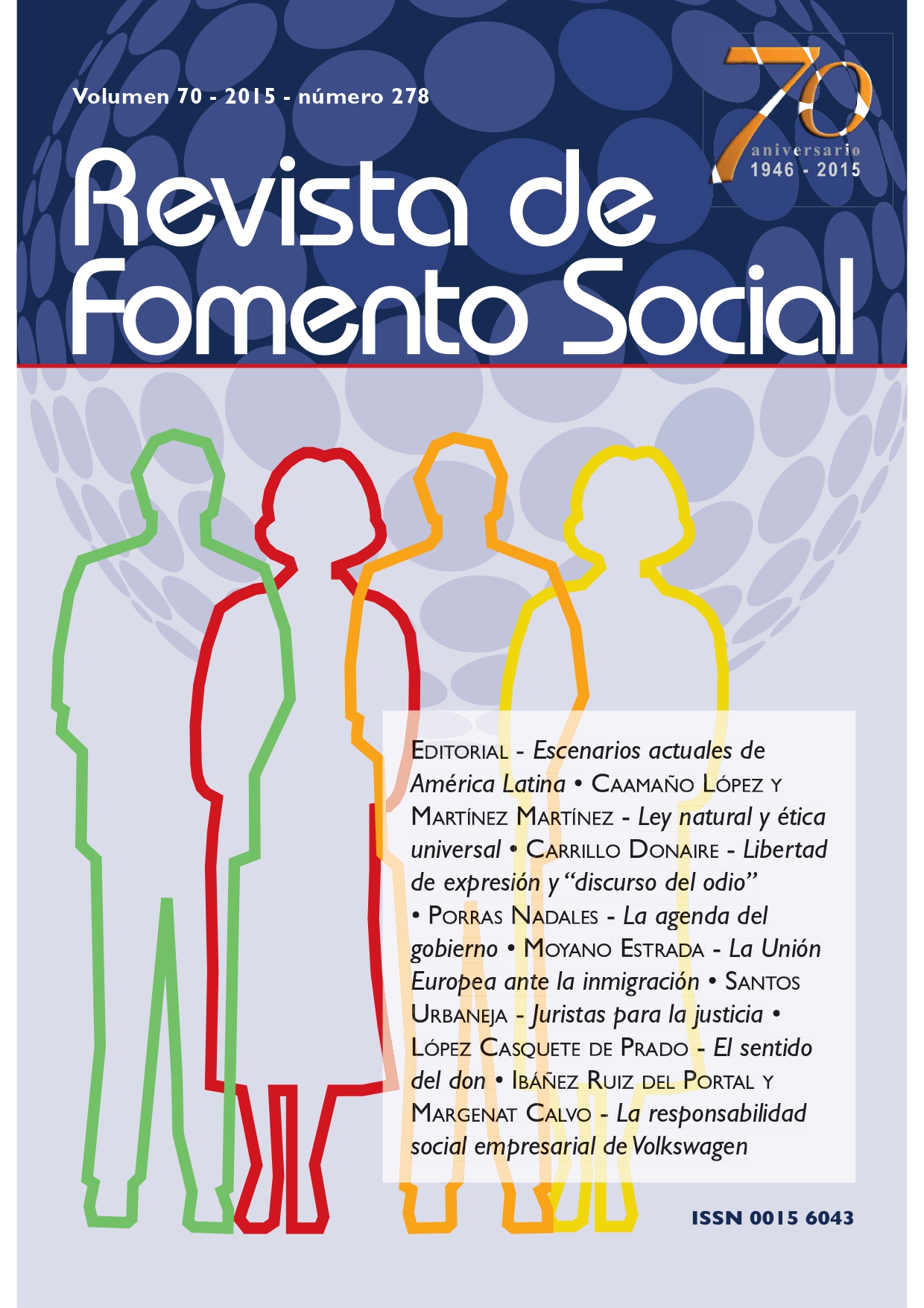
Main Article Content
Abstract
Today we are witnessing new elaborations of political science pertaining to executive power. The author, who published a monograph dedicated precisely to governance, governance and gobermedia, last year (2014) explores in this study the changes that have occurred in the time of weak Governments. At a time of crisis of confidence in the omnipotence of markets, renewed the search for confidence in a new institutional design as political operative projection with Governments that meet expectations that demand its electoral commitments. There is a renewed framework of electoral confidence generated by a reassessment of the commitment between the powers, legislative and Executive, as well as between political action (politics) and by public policies (public policies). The hitherto predominantly “logic programming”, because of the resistance of reality, can end up being replaced by the logic of non–action. Third paragraph, with an explicit reference to the continuing crisis of the social or interventionist State is devoted to that paradigm. The logic of non–action would impose a transformation of the ideal agenda agenda of the Government, paving the way for a shift in the institutional field, who understands that the Government is the engine of the interventionist State, social prominence. From this observation, the author refers to different models of agenda, with various scenarios including the essential public has input. Categories of governance and governance, are now completed by gobermedia, which reaches even to promote virtual responses, of which the practical effects are quite secondary. All this would lead us to a new post–intervencionista context of the State. The study goes from here in a description of the agenda for governance, which could escorar to a kind of subsidiary democracy or so–called “paternalism libertariano”; next to this, the governance agenda would develop him traditional interventionist line through public policies, understood these sectors, although underpinned by Government guidelines. With both agendas (governance, governance), cobra relieva the agenda of gobermedia which aims to capture instant message as an act of Government, even just a Word, a virtual action. It is not an action of Government in the strict sense, but a declaration of intent. All this complexity of the agenda of the Government that has been described happens in new problematic environments, to whose description the fifth section is devoted. In the conclusion the author underlines that the axis of the debate is revolving around the interventionist State, with a background that is crucial to understand the implicit agenda of major public policy. Only this finding will allow a governance model focused on the efficient design of an interventionist action.
Downloads
Article Details
The authors acknowledge that the Revista de Fomento Social assumes as its own the intellectual property rights over their work and grant the journal the permissions of distribution and public communication of the same established in the Berlin, Bethesda and Budapest declarations; for this reason they accept that the work presented be distributed in open access, protecting the copyright under a "Creative Commons Attribution-NonCommercial-NoDerivativeWorks 4.0 (CC BY-NC-ND) license.

You may copy, use, disseminate, transmit and publicly display provided that:
Cite the authorship of the work, the publication in Revista de Fomento Social, issue, year and the pages where you found the information.
No commercial benefit may be obtained.
No derivative works may be made for commercial purposes that are not authorized by the journal.
Authors are encouraged to disseminate the article electronically (Revista de Fomento Social, number, year, pagination, ISSN, DOI, etc.), in order to favor its circulation and diffusion, increase its citation and reach among the academic community.
The information of the journal will be provided to Dulcinea