
A review of the current scenarios in Latin America
Article Sidebar
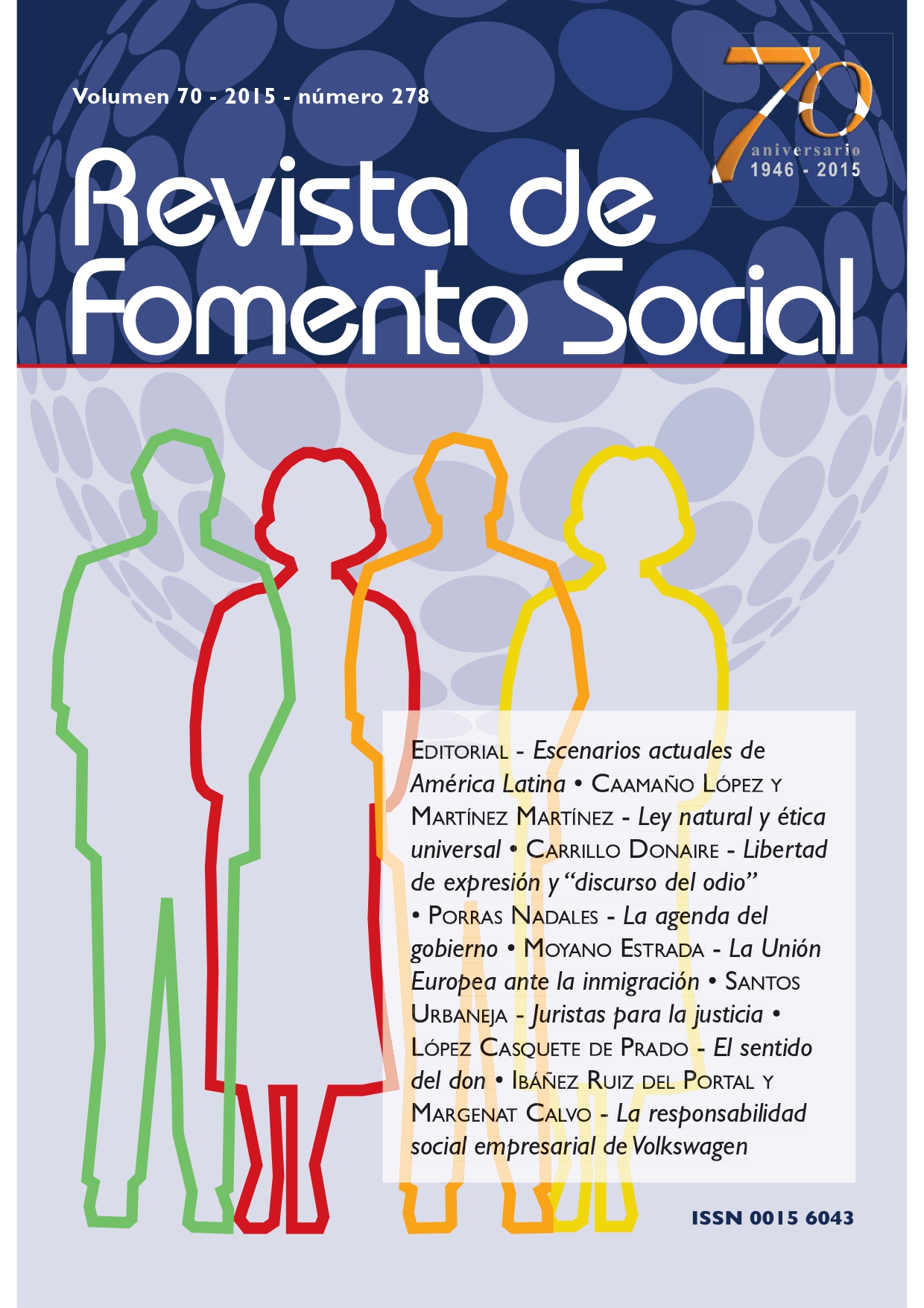
Main Article Content
Abstract
Latin America has changed a lot. What progress has there been in the last ten years of structural changes? While in Spain, and Europe in general, we have experienced a crisis lasting and absorbent, that region has seen to evolve their economic models, seen seated political processes and democratic forms and útlimo it has initiated cultural changes in the context of an increasingly global and globalized world and a time of transformation and crisis of the international system. To the lack of interest of the United States and the failure of Spanish foreign policy, has come to talk about Latin America as one of the protagonists of the “rise of the South”. At this time, we want to take stock of the process and its results. Our magazine offers a global and committed interpretation: Latin America has not been able to capitalize on this extraordinary time, neither in nor in the political, economic and finally also the international crisis – of which will ask us what have been its effects on that continent – to us, Spain, Europe and United States came from 2007 has affected him. In this assessment, we do not want to ignore the actual achievements in complex and geographically different scenarios. On the political stage, seated once without discussion democracy, although this suffer crisis and questions precisely in some countries of the Latin American sub– continent, we are interested in analyzing the changes brought about by the left–wing governments; on the other hand, economic changes, within the international context, are also part of our analysis, as well as the failure of structural adjustment policies, also unsuccessful reduction of inequalities and the pending consolidation of income redistribution programs. Other issues that do not have trestar Hemsö attention, such as violence, insecurity, and the cost of environmental economic policies, also form part of this new model, as well as Latin America policy fragmentation and consolidation of some blocks in the context in which is formulated, successful or confusingly, the new Latin American “regionalism”: the possibilities and limits of a Latin American development model both in its economic base, and the construction of alternative democratic models (which we propose three sketches). Democracy in Latin America, apart from the critical discourse, remains a reality incomplete and vulnerable, with a weak party system, in which the confrontation between the State and the market is still very much alive: after years of economic growth does not seem to have been consolidated a broad middle class, hold necessary and almost forced all democratic settlement. The editorial suggests, as final opening, the opportunity, and even the necessity, of rethinking Latin America already not as homogeneous reality, to get into subregional analyses that do more justice to a plural reality. To broaden this debate we should also include the question of the identity of Latin America from the current perspective of–colonial or post–colonial discourse, as well as the relationship between diversity, indigenism and miscegenation. The question that underlies our reflection revolves around the ability of Latin America to build its own development model. Expectations of ten years do not seem to have been confirmed. Still having questions unanswered: would have improved the foundations of its relations with other key partners?, what happened with the project of a Development Bank for the emerging countries (known as “BRICS”)? In short, for Latin America the central question today is still regionalism opened as a model of development for the next years.
Downloads
Article Details
The authors acknowledge that the Revista de Fomento Social assumes as its own the intellectual property rights over their work and grant the journal the permissions of distribution and public communication of the same established in the Berlin, Bethesda and Budapest declarations; for this reason they accept that the work presented be distributed in open access, protecting the copyright under a "Creative Commons Attribution-NonCommercial-NoDerivativeWorks 4.0 (CC BY-NC-ND) license.

You may copy, use, disseminate, transmit and publicly display provided that:
Cite the authorship of the work, the publication in Revista de Fomento Social, issue, year and the pages where you found the information.
No commercial benefit may be obtained.
No derivative works may be made for commercial purposes that are not authorized by the journal.
Authors are encouraged to disseminate the article electronically (Revista de Fomento Social, number, year, pagination, ISSN, DOI, etc.), in order to favor its circulation and diffusion, increase its citation and reach among the academic community.
The information of the journal will be provided to Dulcinea