
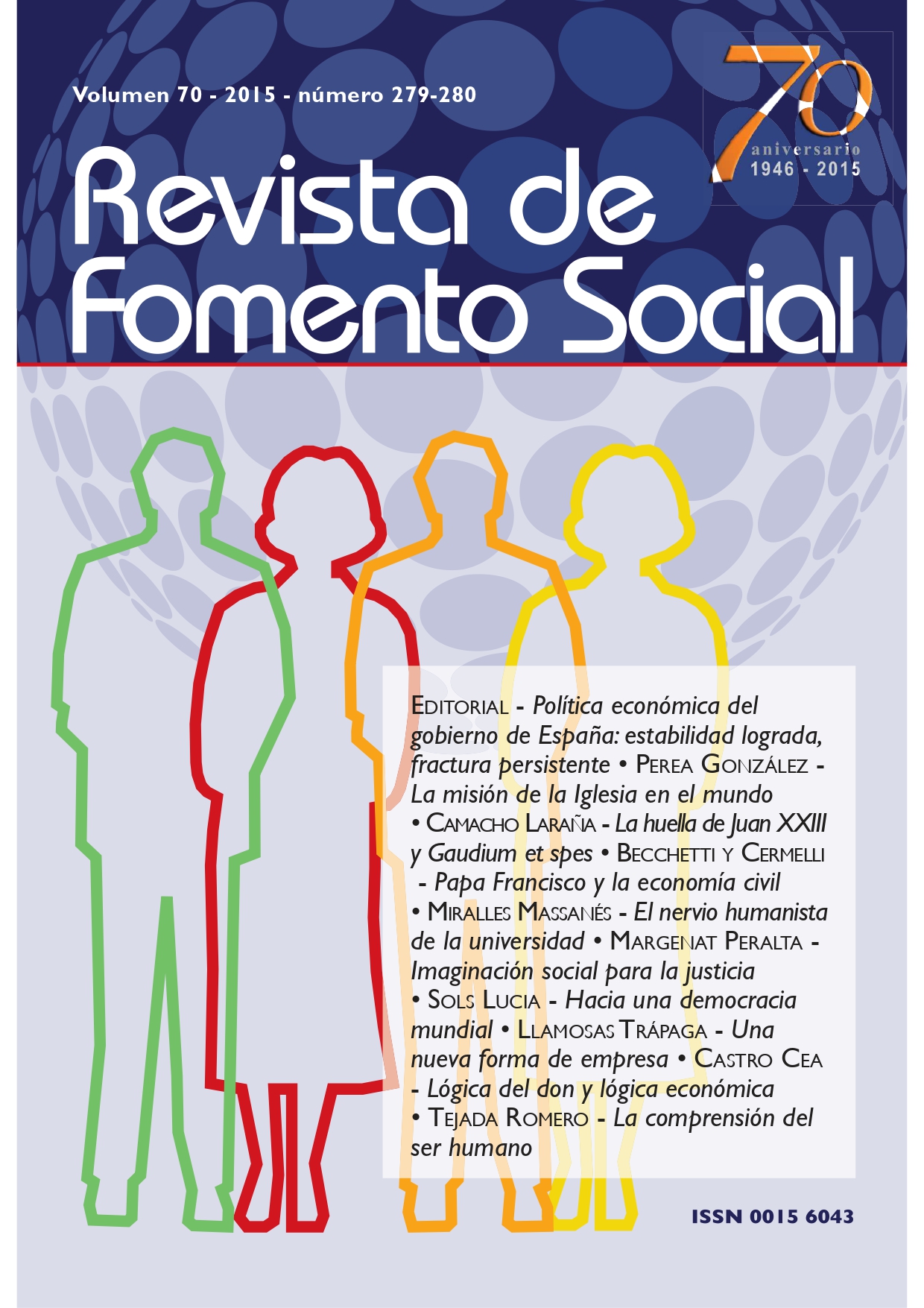
Pope Francis and the civilian economy: one way for the common good in the global economy
Article Sidebar
Main Article Content
Abstract
A change in lifestyle can a healthy pressure on those who hold political, economic and social power. It is what happens when the movements of consumers manage to change the behavior of the businesses, forcing them to consider the environmental impact and the production models. “Buying is always a moral action, as well as economic”. With these words Pope Francis underlines, in his last encyclical Laudato si’, the relevance of the “voto col portafoglio” (voting with the wallet), i.e., the importance of the consumer decisions in the era of the global economy. As stated in the document Gaudium et spes the economy as well as the socio-economic life must be at the service of man and not vice versa. The “civil economy” (“economia civile”) and the "voto col portafoglio" represent today a path from Gaudium et spes to Pope Francis suggests contemporary man as govern the global economy through the common good.
Downloads
Article Details
The authors acknowledge that the Revista de Fomento Social assumes as its own the intellectual property rights over their work and grant the journal the permissions of distribution and public communication of the same established in the Berlin, Bethesda and Budapest declarations; for this reason they accept that the work presented be distributed in open access, protecting the copyright under a "Creative Commons Attribution-NonCommercial-NoDerivativeWorks 4.0 (CC BY-NC-ND) license.

You may copy, use, disseminate, transmit and publicly display provided that:
Cite the authorship of the work, the publication in Revista de Fomento Social, issue, year and the pages where you found the information.
No commercial benefit may be obtained.
No derivative works may be made for commercial purposes that are not authorized by the journal.
Authors are encouraged to disseminate the article electronically (Revista de Fomento Social, number, year, pagination, ISSN, DOI, etc.), in order to favor its circulation and diffusion, increase its citation and reach among the academic community.
The information of the journal will be provided to Dulcinea
References
derivatives, bank assets and growth, mimeo.
BECCHETTI, L. y CERMELLI, M. (2014), “Reduccionismos económicos y “voto con la
cartera”, Revista de Fomento Social 69, 121-135.
BLUNDELL-WIGNALL, A. y ATKINSON, P. (2010), “Global SIFIs, Derivatives and Financial Stability”, OECD Journal: Financial Market Trends 1.
Encíclica Caritas in Veritate (29 de junio del 2009).
Constitución pastoral Gaudium et Spes (7 de diciembre de 1965).
MANNARO, K., MARCHESI, M. y SETZU, A. (2008), “Using an artificial financial market for assessing the impact of Tobin-like transaction taxes,” Journal of Economic
Behavior & Organization, 67 (2), 445-462.
MATHESON, T. (2011) “Taxing Financial Transactions. Issues and Evidence”, IMF Working Paper n. 11/54, marzo, 8.
PELLIZZARI, P. y WESTERHOFF, F. (2009),” Some effects of transaction taxes under different microstructures” Journal of Economic Behavior & Organisation, 72 (3), diciembre, 850-863).
Pontificia Comisión Justicia y Paz (2005), Compendio de Doctrina social de la Iglesia, Roma, Libreria vaticana.
ROUSSEAU, P. y WACHTEL, P. (2009) “What is happening to the impact of financial deepening on economic growth?”: Economic Inquiry 48, DOI:10.1111/j.1465-7295.2009.00197.x
TONIOLO, G. (1873), Dell ‘elemento ético quale fattore intrinseco delle leggi economiche, Padua Università.
U.S. BUREAU OF LABOR STATISTICS (2011), Division of International Labor Comparisons Annual Labor Force Statistics, Adjusted to U.S. Concepts, 10 Countries, 1970-2010, 30, marzo. www.bls.gov/ilc.