
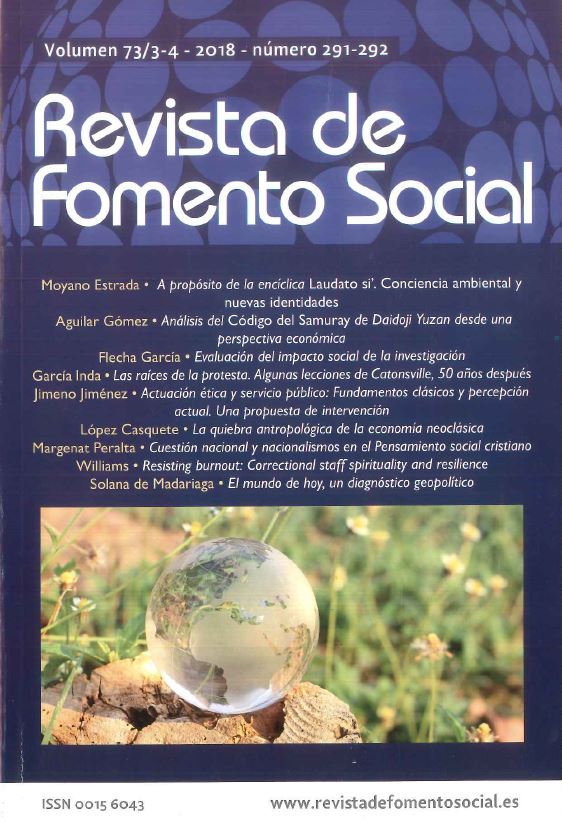
Resisting burnout Correctional staff spirituality and resilience
Article Sidebar
Main Article Content
Abstract
This document summarizes the author’s research on how spirituality helps correctional workers avoid burnout and maintain emotional resilience in their work.
The mixed methods design used an online survey to collect data from COs and correctional chaplains from the Departments of Correction of Oregon and Nevada, measuring their levels of burnout, resilience and spirituality. Qualitative data were collected in follow–up interviews. Findings supported the theoretical premise that COs’ resilience and resistance to burnout are socially learned behaviors and these socially learned behaviors are the result of a dynamic interaction with their prison work environments. COs who score higher on indices of spirituality also scored higher in resilience and lower in burnout measures than COs working in the same environment who did not report spirituality as important to their daily lives.
Downloads
Article Details
The authors acknowledge that the Revista de Fomento Social assumes as its own the intellectual property rights over their work and grant the journal the permissions of distribution and public communication of the same established in the Berlin, Bethesda and Budapest declarations; for this reason they accept that the work presented be distributed in open access, protecting the copyright under a "Creative Commons Attribution-NonCommercial-NoDerivativeWorks 4.0 (CC BY-NC-ND) license.

You may copy, use, disseminate, transmit and publicly display provided that:
Cite the authorship of the work, the publication in Revista de Fomento Social, issue, year and the pages where you found the information.
No commercial benefit may be obtained.
No derivative works may be made for commercial purposes that are not authorized by the journal.
Authors are encouraged to disseminate the article electronically (Revista de Fomento Social, number, year, pagination, ISSN, DOI, etc.), in order to favor its circulation and diffusion, increase its citation and reach among the academic community.
The information of the journal will be provided to Dulcinea
References
BANDURA, A. (2003) “On the Psychosocial Impact and Mechanisms of Spiritual Modeling”. The International Journal for the Psychology of Religion, 13(3), 167–173.
CARLSON, J., ANSON, R. & THOMAS, G. (2003) “Correctional officer burnout and stress: Does gender matter?” The Prison Journal, 83:227–288).
DENHOF, M. D., SPINARIS, C. G. (2013) Depression, PTSD, and Comorbidity in United States Corrections Professionals: Prevalence and Impact on Health and Functioning. Florence: CO Desert Waters Correctional Outreach.
DURKHEIM, E. (1912) The Elementary Forms of Religious Life. Translated by FIELDS, K., & FIELDS, K. E. (1995), New York: Free Press.
FRANKL, V. E. (1959,1985) Man’s search for meaning. Simon and Schuster.
JEFFREYS, D. (2013) Spirituality in Dark Places: the ethics of solitary confinement. Palgrave MacMillan.
MASLACH, C., JACKSON, S. E., & LEITER, M. P. (1981) Maslach Burnout Inventory: MBI. Consulting. Psychologists Press.
MASLOW, A. H. (1968) Toward a psychology of being. NewYork: Van Reinhold.
PEPINSKY, H. & QUINNEY, R. (1991) Criminology as Peacemaking. Bloomington, Indiana: University Press.
UNITED STATES DEPARTMENT OF COMMERCE, THE U.S. CENSUS BUREAU (2016) Washington, DC. Retrieved 2/8/2916 from http://www.census.gov/programs–surveys/cps.html
WAGNILD, G. M. (2011) The resilience scale user’s guide: For the US English version of the Resilience Scale and the 14–item Resilience Scale (RS–14). P. E. Guinn (Ed.). Resilience Center.
WESTER, F. E. (2010) Soldier Spirituality in a Combat Zone: Preliminary Findings About Correlations with Ethics and Resiliency. Journal of Healthcare, Science and the Humanities, 1, 67–86.