
The anthropological breakdown of the neoclassical economics
Article Sidebar
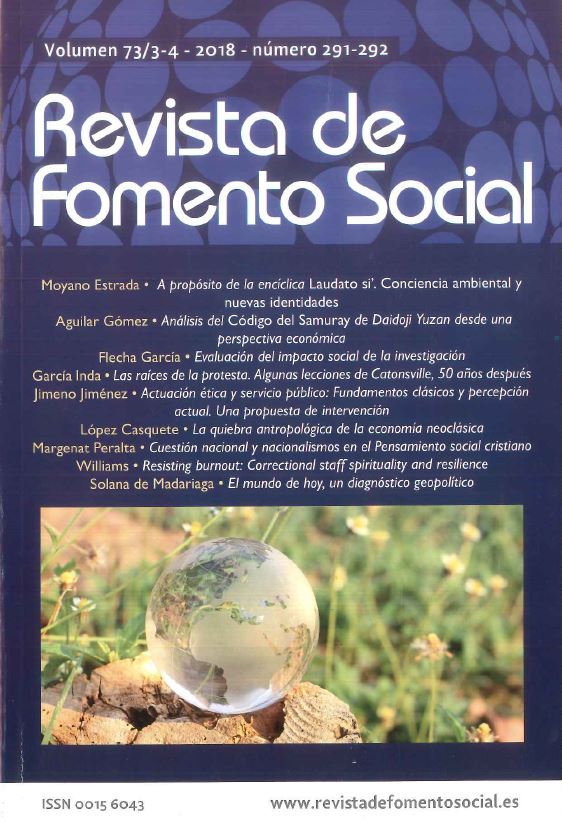
Main Article Content
Abstract
Neoclassical economics takes as one of its main foundations the reflection contained in The Wealth of Nations by Adam Smith, which derives an understanding of man as being exclusively focused on maximizing his particular interest. However, to carry out a correct understanding of the work of Smith, it is necessary to analyze the anthropological basis contained in his work, certainly much more complex than the one considered by the neoclassical tradition. In this article we aim to study the anthropological approach of Adam Smith, to show the deviations in the reception and interpretation of this approach and some of the consequences that it has generated in our economic development. For this purpose, we offer a comparison between the anthropological basis of the neoclassical Economy and a more complete focus raised by the French philosopher Jacques Maritain. From the comparison between these two models, we conclude the need of rebuilding the anthropological bases in the current economic development, heiress of neoclassical, in a more complete and comprehensive vision of the wealth of human nature.
Downloads
Article Details
The authors acknowledge that the Revista de Fomento Social assumes as its own the intellectual property rights over their work and grant the journal the permissions of distribution and public communication of the same established in the Berlin, Bethesda and Budapest declarations; for this reason they accept that the work presented be distributed in open access, protecting the copyright under a "Creative Commons Attribution-NonCommercial-NoDerivativeWorks 4.0 (CC BY-NC-ND) license.

You may copy, use, disseminate, transmit and publicly display provided that:
Cite the authorship of the work, the publication in Revista de Fomento Social, issue, year and the pages where you found the information.
No commercial benefit may be obtained.
No derivative works may be made for commercial purposes that are not authorized by the journal.
Authors are encouraged to disseminate the article electronically (Revista de Fomento Social, number, year, pagination, ISSN, DOI, etc.), in order to favor its circulation and diffusion, increase its citation and reach among the academic community.
The information of the journal will be provided to Dulcinea
References
BENTHAM, J. (1969) An introduction to the principles of morals and legislation. Nueva York: M. P. Mack.
BRUNI, L. y ZAMAGNI, S. (2004) Economia civile. Efficienza, equità, felicità pubblica. Bolonia: Il Mulino.
CESAREO, V. y VACCARINI, I. (2006) La libertà responsabile. Soggettività e mutamento sociale. Milán: Vita e Pensiero.
CORTINA, A. (2007) Ética de la razón cordial. Oviedo: Nóbel.
DI TOMMASO, G. (2012) “Persona e libertà responsabile” en La persona nella teoria sociologica contemporanea. Ed. a cargo de FERONE, E. y GERMANO, I. S. Torino: Harmattan Italia.
FERNÁNDEZ AGUAYO, S. (2011) “Equidad, justicia social y algo más”, Notes et documents nº 20.
FILANGERI, G. (2003) La scienza della legislazione. Nápoles: Grimaldi & C.
GATTAMORTA, L. (2012) “Persona e sociologia fenomenologica di Max Scheler e Alfred Schütz” en La persona nella teoria sociologica contemporanea. Ed. a cargo de FERONE, E. y GERMANO, I. S. Torino: Harmattan Italia.
GENOVESI, A. (2013) Lezioni di economia civile [1769]. Ed. a cargo de DAL DEGAN, F. Milán: Vita e pensiero.
Maritain, J. (1933) Du régime temporel et de la liberté, en Oeuvres complètes (1986), Friburgo (Suiza) – París: Saint Paul.
— (1936) Humanisme intégral, en Oeuvres complètes (1986), Friburgo (Suiza) – París: Saint Paul.
— (1939) Confession de foi, en Oeuvres complètes (1986), Friburgo (Suiza) – París: Saint Paul.
— (1942) Les droits de l’homme et la loi naturelle, en Oeuvres complètes (1986), Friburgo (Suiza) – París: Saint Paul.
— (1944) Principes d’une politique humaniste, en Oeuvres complètes (1986), Friburgo (Suiza) – París: Saint Paul.
— (1947) La personne et le bien commun, en Oeuvres complètes (1986), Friburgo (Suiza) – París: Saint Paul.
MARSHALL, A. (1892) Elements of Economics of Industry. Londres: MacMillan and Co.
OKUN, A. (1975) Equality and Efficiency: The Big Tradeoff. Washington: Brookings Classics.
PARETO, V. (1966) Manuel d’economie politique en Obras completas, tomo VII. Ginebra: Droz.
PIGOU, A. (1920) The economics of welfare. Londres: MacMillan and Co.
POSSENTI, V. (2007) “La nozione di bene comune e l’universalità”, Notes et documents nº 9, pp. 36–47.
RIGOBELLO, A. (1978) Il personalismo. Roma: Città Nuova.
ROBINSON, J. (1946) The pure theory of international trade. RES.
SCREPANTI, E. y ZAMAGNI, S. (2004) Profilo di storia del pensiero economico. Roma: Carocci.
SMITH, A. (1941) Teoría de los Sentimientos Morales. México: Fondo de Cultura Económica.
— (2007) An inquiry into the nature and causes of the wealth of nations. Petersfield (Reino Unido), Harriman House.
TABARRO, C. (2010) Dalla società del rischio all’economia civile. Bolonia: Pardes.
WICKSTEED, P. H. (1910) The common sense of Political Economy. Londres: MacMillan and Co.
ZAMAGNI, S. (2008) “La economía civil y los bienes relacionales”, en Viale, R. (coord.), Las nuevas economías. De la economía evolucionista a la economía cognitiva: más allá de las fallas de la teoría clásica. México: Flacso.
— (2010) “Catholic social thought, civil economy and the spirit of capitalism” en Finn, D. K. (coord.), The true wealth of nations. Oxford University Press.
— (2012A) “L’economia civile: perché la decrescita non è la soluzione”, News, periodico di Ateneo, año XIV, nº 2.
— (2012B) Por una economía del bien común. Madrid: Ciudad Nueva.