
Analysis of the Samurai Code of Daidoji Yuzan from an economic perspective
Article Sidebar
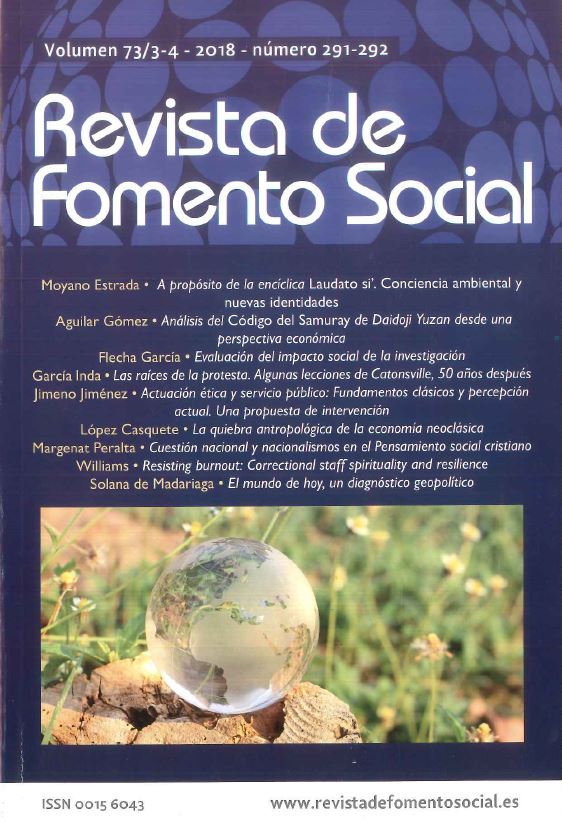
Main Article Content
Abstract
This work follows the recent trend of studying the economic content of works that do not have an economic character, whether they are philosophical works, literature, etc. The Bushido was a code of conduct and ethics that existed in Japan in the Middle Ages, from the 12th century until the end of the 19th century. The Bushido as a philosophy and code of conduct emerged in the twelfth century and will be in force for seven centuries until its abolition in 1868, with the industrial revolution and the dismantling of traditional society although this does not mean that it remains present in Japan of life political, social and economic. It responds to the objective of analyzing the economic content of Yuzan’s text.
Downloads
Article Details
The authors acknowledge that the Revista de Fomento Social assumes as its own the intellectual property rights over their work and grant the journal the permissions of distribution and public communication of the same established in the Berlin, Bethesda and Budapest declarations; for this reason they accept that the work presented be distributed in open access, protecting the copyright under a "Creative Commons Attribution-NonCommercial-NoDerivativeWorks 4.0 (CC BY-NC-ND) license.

You may copy, use, disseminate, transmit and publicly display provided that:
Cite the authorship of the work, the publication in Revista de Fomento Social, issue, year and the pages where you found the information.
No commercial benefit may be obtained.
No derivative works may be made for commercial purposes that are not authorized by the journal.
Authors are encouraged to disseminate the article electronically (Revista de Fomento Social, number, year, pagination, ISSN, DOI, etc.), in order to favor its circulation and diffusion, increase its citation and reach among the academic community.
The information of the journal will be provided to Dulcinea
References
— (2010) “Los cuatro libros sagrados del confucianismo: una lectura económica”. Revista Empresa y Humanismo. Vol. XIII, nº 2/10.
— (2011) El contenido económico del libro sagrado budista: el Dhammapada. Revista Empresa y Humanismo. Vol. XV, nº 2/12.
CHEN, K., IMROHOROGLUA, A., y IMROHOROGLU, S. (2009) “The Japanese Saving Rate”. American Economic Review. Vol. 6, nº 5.
CLEARY, T. (1998) El arte japonés de la guerra. El Bushido en la economía y en la política del Japón actual. Madrid, EDAF.
DIFFENDERFFER, B. (2007) El Líder Samurái. Madrid, Temas de Hoy.
GARCÍA–CARO NÚÑEZ, A. (2008) “La deuda pública en Japón”. Observatorio Latinoamericano de la Economía y la Sociedad del Japón. Vol. I, nº 3.
GARCÍA LIZANA, A. y AGUILAR GÓMEZ, J. (2008) “La economía en el Libro del Buen Amor: sobre avaricia y pobreza”. En Toros, F. y Haywood, L. (coord.) (2008) Juan Ruiz Arcipestre de Hita y el Libro del Buen Amor. Alcalá la Real, Ayuntamiento de Alcalá la Real, pp. 195–204.
GARCÍA LIZANA, A. y CALERO SECALL, M. I. (2009) “La economía en el Libro de Las Banderas de los Campeones”. Estudios de Frontera. Alcalá la Real, Ayuntamiento de Alcalá la Real.
GARCÍA LIZANA, A. y AGUILAR GÓMEZ, J. (2011) “El tema de las riqueza en las tradiciones de occidente y oriente: algunas reflexiones sobre El Libro del Buen Amor, el Dhammapada y el Código del Samuráy”, en TOROS, F. y GODINAS, L. (2011) Juan
Ruiz Arcipestre de Hita y el Libro del Buen Amor. Alcalá la Real, Ayuntamiento de Alcalá la Real, pp. 115–122.
GRICE–HUTCHINSON, M. (1995) Ensayos sobre el pensamiento económico en España. Madrid, Alianza.
Hawkins, V. y Gaskin, C. (2008) Breve historia de los samuráis. Madrid, Nowtilus.
López Vera, J. (2016) Historia de los Samuráis. Madrid, Satori.
Martos, J.A. (2006) “Samurais”. Clío. Nº 51. Madrid.
Martín Alarcón, P. (2001) Japón: origen y forja. Mitología religión y filosofía. Málaga, Asociación deportiva y cultural Daysu.
Nitobe, I. (2002) El Bushido. El alma del Japón. Barcelona, Olañeta.
Segura Simón, F. (2000) Manual de Historia Económica Mundial y de España. Madrid, Centro de Estudios Ramón Areces.
Rati, O. y Westbrook, A. (2005) Secretos de los Samurais. Madrid, Paitotribo.
Rodao, F. (2015) “Crisis y continuidad en el sistema político japonés”. Jornadas sobre el desarrollo y cooperación en Asia. Universidad de Vigo.
Romero Fernández, A. (2006) “Bushido. Código del Samurái”. Revista de Historia. Nº 359, pp. 8–31.
Rubio, C. (2017) “Samuráis. Las guerras entre clanes de Japón”. Historia. National Geographic.
Clements, J. (2010) Los samuráis. Barcelona, Crítica.
Segura Simón, F. (2000) Manual de Historia Económica Mundial y de España. Madrid, Centro de Estudios Ramón Areces.
Takayama, K. (2015) “Why does Japan`s Saving Rate Decline So Rapidly? Policy Research Institute. Ministre of Finance. Japan.
Tamames, R. (2005) “La condición económica de Don Quijote y Sancho en la sociedad española del siglo de oro. Información Comercial Española nº 824. Madrid, pp. 141–154.
TAMAMES, R. y GALLEGO, S. (2006) Diccionario de Economía y Finanzas. Madrid, Alianza.
TSUNEMOTO, Y. (2004) Hagakure. El libro del Samurái. Barcelona, Olañeta.
— (2005) Bushido. El camino del Samurái. Barcelona, Paidotribo.
Yuzan D. [S XVI] (2011) El Código del Samuray. Versión de A.L. Sadler. Madrid, EDAF.