
The anthropology of Gaudium et spes
Article Sidebar
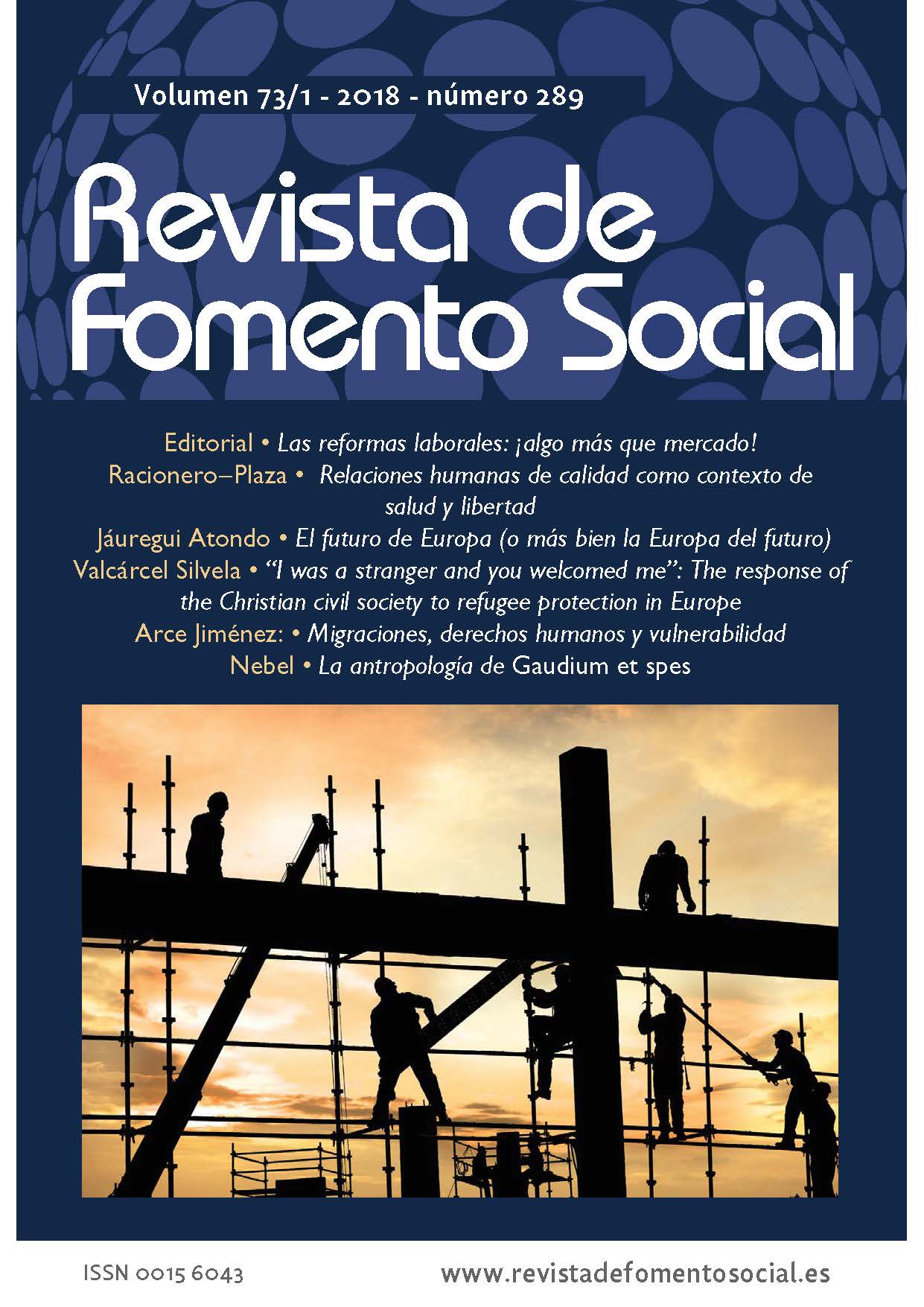
Main Article Content
Abstract
The author, taking into account the overabundance of studies published up to now, and especially in the fiftieth anniversary part of the public reason, because, even if its rationality be transcendental, it does not fail to be communicable and nderstandable by other interlocutors. The author suspects that the failure of the secularized dialogue can be because of the selfcensorship of the religious discourse in the field of the public entity. In the second part, the author emphasizes the need of the moral judgment, and criticizes its absence in the public discourse and in the theological ethics, a necessary judgment so as to be able to humanize the world. Only through the ethical discernment, opened by the means of the theological discourse about the world, shall we be able to give of the Conciliar pastoral constitution Gaudium et spes, which have fixed the history of the redaction, and of the debates in the Conciliar years, and given that we live and think in very different historic contexts, adopts a phenomenological and hermeneutic perspective.reason of the meaning of our hope, what raises the need to rehabilitate the value and the status of that ethical judgment. The failure of the purpose of dialogue with the world, intended by the Church, contrary to what happened in the Sixties of last century, defines the present situation.
Downloads
Article Details
The authors acknowledge that the Revista de Fomento Social assumes as its own the intellectual property rights over their work and grant the journal the permissions of distribution and public communication of the same established in the Berlin, Bethesda and Budapest declarations; for this reason they accept that the work presented be distributed in open access, protecting the copyright under a "Creative Commons Attribution-NonCommercial-NoDerivativeWorks 4.0 (CC BY-NC-ND) license.

You may copy, use, disseminate, transmit and publicly display provided that:
Cite the authorship of the work, the publication in Revista de Fomento Social, issue, year and the pages where you found the information.
No commercial benefit may be obtained.
No derivative works may be made for commercial purposes that are not authorized by the journal.
Authors are encouraged to disseminate the article electronically (Revista de Fomento Social, number, year, pagination, ISSN, DOI, etc.), in order to favor its circulation and diffusion, increase its citation and reach among the academic community.
The information of the journal will be provided to Dulcinea