
Benedict XVI and ecumenism
Article Sidebar
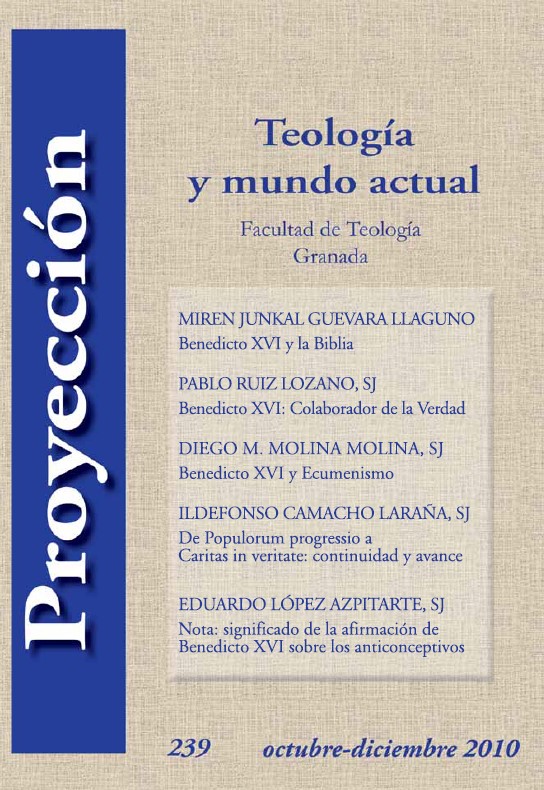
Main Article Content
Abstract
Joseph Ratzinger said that one of the consequences of Vatican II is that theology already could not be otherwise but to have an ecumenical dimension, and this is something that has been maintained in all his work. And thus, from the beginning of his pontificate, Benedict XVI assumed as an important mission, the work for the union of the Churches, which explains why the interventions he has carried out, related to ecumenism, are so numerous. This article analyses, on the one hand, the underlying themes, which we may consider as connecting themes of his ecumenical thought, and which appear in one form or another in his writings or actions: the passion for truth, the understanding of unity which is at the basis of his interventions, the need for conversion of all Christians in order to reach that unity… On the other hand, he pauses in some concrete themes which have in a special way taken up the theological work of the present Pope, and which have a great ecumenical repercussion, as for example the Petrine ministry, the issue of the “subsistit in”, or the relation between the universal Church and the local churches.
Downloads
Article Details
Previously, the journal was copyrighted. Now, since 2021, the journal publishes under the Creative Commons license.
Authors who publish in Proyección. Teología y Mundo Actual, accept the following conditions:
Authors retain copyright © and grant the journal the right of publication, under Creative Commons Attribution-NonCommercial-NoDerivativeWorks 4.0 (CC BY-NC-ND) license.
You may copy, use, disseminate, transmit, and publicly display provided that:
* Cite authorship of the work, publication in Proyección. Teología y Mundo Actual, number, year and the pages where the information was found.
* No commercial benefit may be obtained.
* No derivative works may be made for commercial purposes that are not authorized by the journal.
Authors are allowed and encouraged to disseminate the article electronically (Proyección. Teología y Mundo Actual, logo or cover of the journal, pagination, indication of the volume and number of the journal, ISSN, DOI, etc.), in order to favor its circulation and diffusion, and to increase its citation and reach among the academic community.