
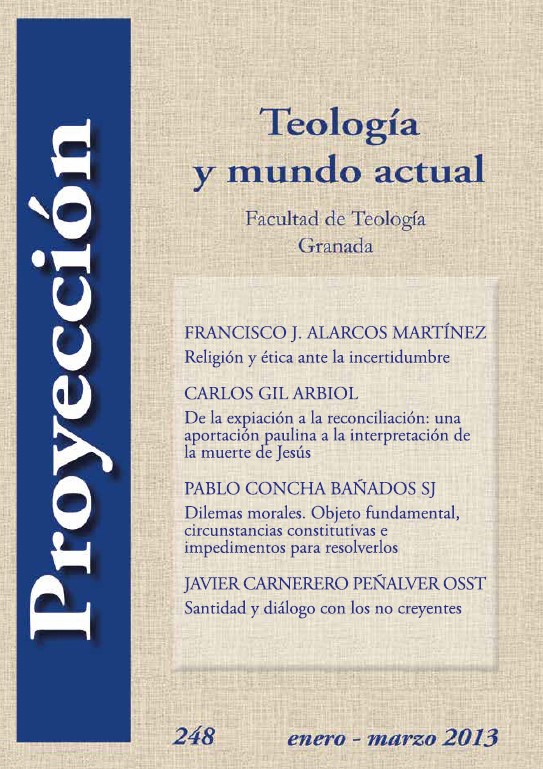
Holiness and dialogue with non-believers
Article Sidebar
Main Article Content
Abstract
The experience of a Sister from the Most Holy Trinity congregation, at the concentration camp of Auschwitz, shows us holiness as a key for interreligious dialogue, and for the dialogue with non-believers. The exemplary life of Sister Autsch produced a deep impact on those who lived with her, and motivated them to remain human beings in that terrible situation. It brought them to recognize in her faith and religiosity, the motor and the force of her heroic deed, and also to see God in her, in spite of not sharing her faith. In the same way, being able to accept and receive the other, loving him/her as God himself loves, independently of their creed or ideology, she spanned a bridge of communication which hardly could be achieved by any other means.
Downloads
Article Details
Previously, the journal was copyrighted. Now, since 2021, the journal publishes under the Creative Commons license.
Authors who publish in Proyección. Teología y Mundo Actual, accept the following conditions:
Authors retain copyright © and grant the journal the right of publication, under Creative Commons Attribution-NonCommercial-NoDerivativeWorks 4.0 (CC BY-NC-ND) license.
You may copy, use, disseminate, transmit, and publicly display provided that:
* Cite authorship of the work, publication in Proyección. Teología y Mundo Actual, number, year and the pages where the information was found.
* No commercial benefit may be obtained.
* No derivative works may be made for commercial purposes that are not authorized by the journal.
Authors are allowed and encouraged to disseminate the article electronically (Proyección. Teología y Mundo Actual, logo or cover of the journal, pagination, indication of the volume and number of the journal, ISSN, DOI, etc.), in order to favor its circulation and diffusion, and to increase its citation and reach among the academic community.