
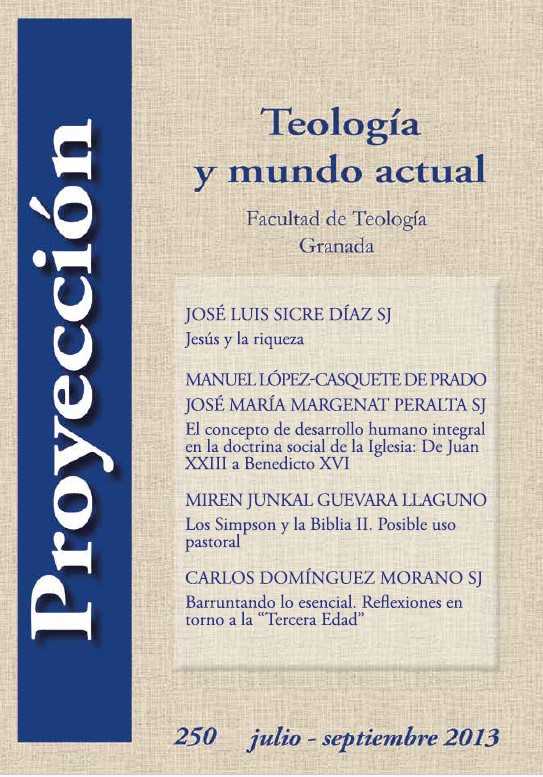
The Concept of integral human development in the social doctrine of the church From John XXIII to Benedict XVI
Article Sidebar
Main Article Content
Abstract
From the title of the encyclical Caritas in Veritate (2009) is indicated that the text seeks rethink and update the teachings of the encyclical Populorum Progressio of Pope Paul VI (1967) on integral human development. It makes clear the importance of this concept not only in Caritas in Veritate, but throughout the evolution of the Catholic Social Teaching in the last half century. In this paper we propose a thorough study of the idea of human development from John XXIII to Caritas in Veritate. We show how the most genuine contribution of the encyclical of Benedict XVI is to provide an idea of development as constitutive of the human need to experience a gradual opening to love in truth, and how it finds in the free gift a true pedagogy to teach brotherhood, responsibility, openness to others and, ultimately, to the transcendence. In other words, a pedagogy that points to the ideal of integral human development.
Downloads
Article Details
Previously, the journal was copyrighted. Now, since 2021, the journal publishes under the Creative Commons license.
Authors who publish in Proyección. Teología y Mundo Actual, accept the following conditions:
Authors retain copyright © and grant the journal the right of publication, under Creative Commons Attribution-NonCommercial-NoDerivativeWorks 4.0 (CC BY-NC-ND) license.
You may copy, use, disseminate, transmit, and publicly display provided that:
* Cite authorship of the work, publication in Proyección. Teología y Mundo Actual, number, year and the pages where the information was found.
* No commercial benefit may be obtained.
* No derivative works may be made for commercial purposes that are not authorized by the journal.
Authors are allowed and encouraged to disseminate the article electronically (Proyección. Teología y Mundo Actual, logo or cover of the journal, pagination, indication of the volume and number of the journal, ISSN, DOI, etc.), in order to favor its circulation and diffusion, and to increase its citation and reach among the academic community.