
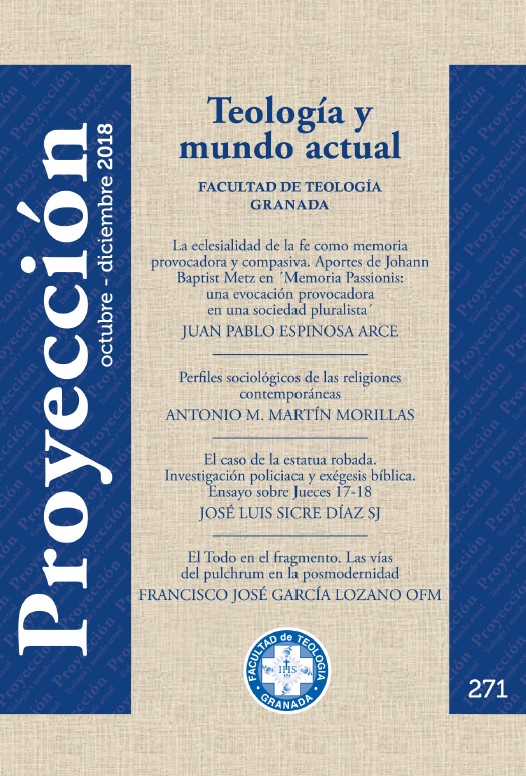
The Whole in the fragment. The paths of the pulchrum in postmodernity.
Article Sidebar
Main Article Content
Abstract
Modernity has meant a decisive division around the problem of God. The exhaustion of the discursive ways means the revival of the analogical ways to that access. The transcendentals of Scholasticism were a form of tackling the plurality of the ens. Since all the created entia are characterized by the unity, the truth, the goodness and the beauty according to diverse degrees, this participation of the transcendentals in everything created, brings human reason not only to the possibility of knowing everything that exists, and thus of being capax entis, but also brings it to the knowledge of the source of the transcendental, in such a way that the human reason is thus capax Dei. In this article we deal with the ways of the pulchrum, as a transcendental of being, and its postmodern concretions starting from the critical philosophy of the art of Chul-Han and its implications in a philosophy of the subject.
Downloads
Article Details
Previously, the journal was copyrighted. Now, since 2021, the journal publishes under the Creative Commons license.
Authors who publish in Proyección. Teología y Mundo Actual, accept the following conditions:
Authors retain copyright © and grant the journal the right of publication, under Creative Commons Attribution-NonCommercial-NoDerivativeWorks 4.0 (CC BY-NC-ND) license.
You may copy, use, disseminate, transmit, and publicly display provided that:
* Cite authorship of the work, publication in Proyección. Teología y Mundo Actual, number, year and the pages where the information was found.
* No commercial benefit may be obtained.
* No derivative works may be made for commercial purposes that are not authorized by the journal.
Authors are allowed and encouraged to disseminate the article electronically (Proyección. Teología y Mundo Actual, logo or cover of the journal, pagination, indication of the volume and number of the journal, ISSN, DOI, etc.), in order to favor its circulation and diffusion, and to increase its citation and reach among the academic community.