
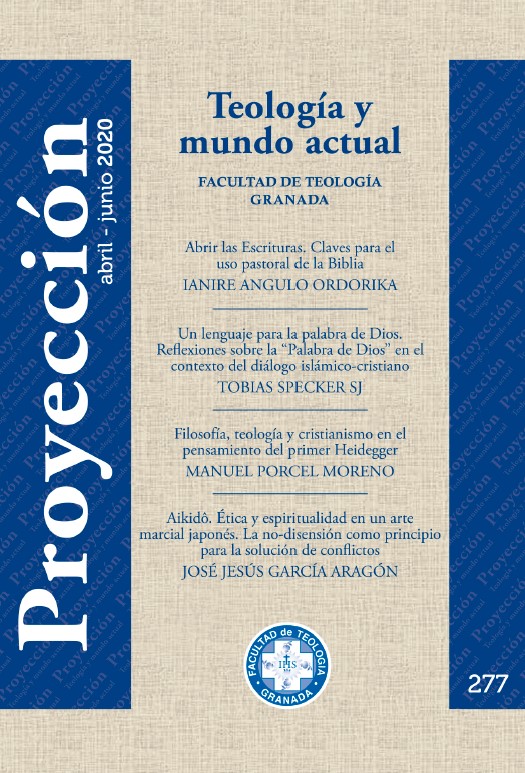
Aikido Ethics and spirituality in a Japanese martial art. Non-dissension as a principle of conflict resolution
Article Sidebar
Main Article Content
Abstract
It seems a contradiction that a method for conflict resolution is a martial art. This is the case of aikidô, which has evolved to express a positive aspect of the tradition of the Japanese bushi culture. It is a budô based on the philosophy of non-resistance, which promotes non-violence and develops the culture of peace; non-dissension as a principle. Its founder, Ueshiba Morihei, who had mystical experiences, turned aikidô into a method of self-defense; with the ethical intention of defending yourself without harming the aggressor. It seeks to develop a practical knowledge of self-control at physic-technical, aesthetic, psycho-mental, and ethical-spiritual levels, which helps to reach a higher level of consciousness.
Downloads
Article Details
Previously, the journal was copyrighted. Now, since 2021, the journal publishes under the Creative Commons license.
Authors who publish in Proyección. Teología y Mundo Actual, accept the following conditions:
Authors retain copyright © and grant the journal the right of publication, under Creative Commons Attribution-NonCommercial-NoDerivativeWorks 4.0 (CC BY-NC-ND) license.
You may copy, use, disseminate, transmit, and publicly display provided that:
* Cite authorship of the work, publication in Proyección. Teología y Mundo Actual, number, year and the pages where the information was found.
* No commercial benefit may be obtained.
* No derivative works may be made for commercial purposes that are not authorized by the journal.
Authors are allowed and encouraged to disseminate the article electronically (Proyección. Teología y Mundo Actual, logo or cover of the journal, pagination, indication of the volume and number of the journal, ISSN, DOI, etc.), in order to favor its circulation and diffusion, and to increase its citation and reach among the academic community.