
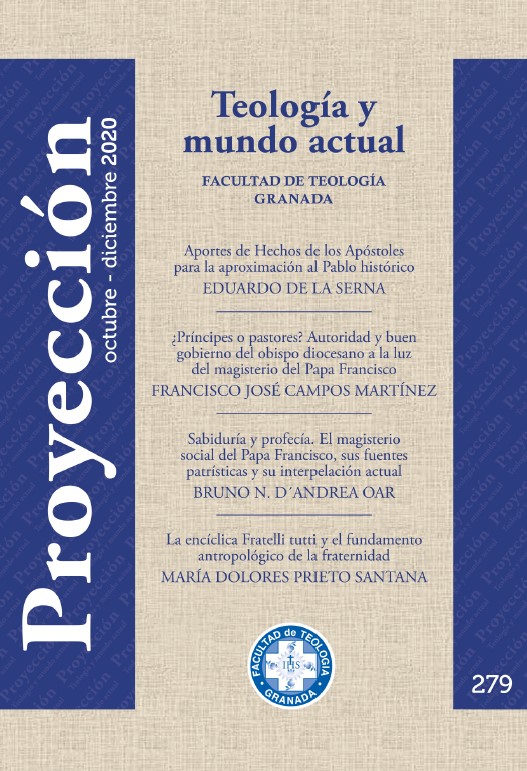
Princes or shepherds? Authority and good governance of the diocesan bishop in the light of the magisterium of pope francisco
Article Sidebar
Main Article Content
Abstract
The objective of this article is to offer a reflection on the authority and government of the diocesan bishop in light of the Second Vatican Council, the Post-Synodal Exhortation on the Bishops Pastores Gregis, the Directory for the pastoral ministry of the bishops Apostolorum Successores and, especially, the magisterium of Pope Francis. This reflection begins with a brief exposition on the etymological, biblical-theological and canonical meaning of the term authority. All of these sources account for a renewed understanding of episcopal authority and power within the conciliar framework of the ecclesiology of communion. Pope Francis, with his peculiar pedagogy, offers a pastoral translation of all that reflection and magisterial dispositions so that the life and ministry of the bishops be truly fruitful and in tune with the council teaching and his pastoral project of renewal of the whole Church, crystallized in the images of an outgoing Church, which be a field hospital and whose doors be open to all.
Downloads
Article Details
Previously, the journal was copyrighted. Now, since 2021, the journal publishes under the Creative Commons license.
Authors who publish in Proyección. Teología y Mundo Actual, accept the following conditions:
Authors retain copyright © and grant the journal the right of publication, under Creative Commons Attribution-NonCommercial-NoDerivativeWorks 4.0 (CC BY-NC-ND) license.
You may copy, use, disseminate, transmit, and publicly display provided that:
* Cite authorship of the work, publication in Proyección. Teología y Mundo Actual, number, year and the pages where the information was found.
* No commercial benefit may be obtained.
* No derivative works may be made for commercial purposes that are not authorized by the journal.
Authors are allowed and encouraged to disseminate the article electronically (Proyección. Teología y Mundo Actual, logo or cover of the journal, pagination, indication of the volume and number of the journal, ISSN, DOI, etc.), in order to favor its circulation and diffusion, and to increase its citation and reach among the academic community.