
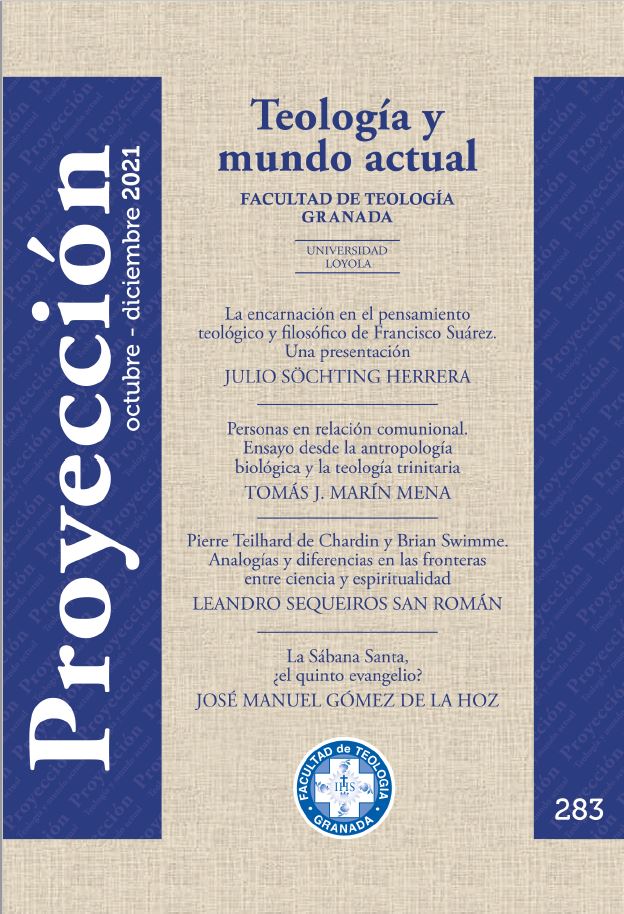
People in communional relationship. An Essay from Biological Anthropology and Trinitarian theology
Article Sidebar
Main Article Content
Abstract
The main aim of this paper is to present that the human person is defined constitutively by being in relation to other persons. Person is essentially open to communion. And this is not an abstract concept, since the specifically human morphological-corporeal elements (biped-erect posture, hand, face, size and complexity of the brain, bucosupralaryngeal structure, slowed down and discontinuous growth and physiologically early birth) require, in their operation, the cooperation of the other. Beside, if we look at the human person in the light of Trinitarian theological reflection, taking the divine person as the analogatum princeps, we discover that the human person is equally conceived in relation to other person, including divine Trinity. From this perspective, the following are defining notes: the ontological primacy of the person, the call to intercompenetration, the role of the third person and the communion of plural singularities. Finally, it will be pointed out how Christian theology find the link between reflection on human embodiment and on the Trinitarian aspects in the incarnation of the eternal Word.
Downloads
Article Details
Previously, the journal was copyrighted. Now, since 2021, the journal publishes under the Creative Commons license.
Authors who publish in Proyección. Teología y Mundo Actual, accept the following conditions:
Authors retain copyright © and grant the journal the right of publication, under Creative Commons Attribution-NonCommercial-NoDerivativeWorks 4.0 (CC BY-NC-ND) license.
You may copy, use, disseminate, transmit, and publicly display provided that:
* Cite authorship of the work, publication in Proyección. Teología y Mundo Actual, number, year and the pages where the information was found.
* No commercial benefit may be obtained.
* No derivative works may be made for commercial purposes that are not authorized by the journal.
Authors are allowed and encouraged to disseminate the article electronically (Proyección. Teología y Mundo Actual, logo or cover of the journal, pagination, indication of the volume and number of the journal, ISSN, DOI, etc.), in order to favor its circulation and diffusion, and to increase its citation and reach among the academic community.